Showing posts with label sign language. Show all posts

Thursday, November 28, 2013

Correct sign for "cochlear implant"

Ever noticed how some deaf people improperly sign "cochlear implant" which resembles closely the sign for "Frankenstein" where one of the bolt sticks out of Frankenstein's neck?


Many do purposely sign "cochlear implant" on the neck because of their bias against cochlear implant rather than correctly signing it.  One can effectively make an argument for or against cochlear implant while signing correctly the sign for "cochlear implant" instead of signing it in an unprofessional manner with such subtlety as a way to mock those with cochlear implants seeing them as "monsters."

Some will defend their signing and say they are "lazy" to sign it correctly. If they actually come up with that excuse then you will know they are not being honest about it.  The cochlear implant goes nowhere near the neck. And they know that.

Monday, November 11, 2013

Proof when voice is more effective than signing....


Or is it?

Well, one person was the Chapter president (Sacramento) of California Association of the Deaf, an organization who pride themselves their strong heritage on using ASL, used his voice instead at a California Senate Health Hearing discussing the AB2072 bill in a roomful of culturally deaf people which would make Alexander G. Bell Association for the Deaf and Hard of Hearing, John Tracy Clinic, Oberkotter Foundation and all of the oral/aural schools around the United States quite proud.


Sign language interpreters were at the hearing to help interpret both voice and sign language.  Yet it's perfectly alright to use your voice, even at Gallaudet University, CSUN, or elsewhere as long as there are interpreters and/or CART services available so that everyone, deaf, hard of hearing and/or hearing can understand what's being said. Tim Riker, former chapter president of CAD, made it perfectly clear on June 23, 2010 at the California Senate Health Hearing that using his voice was wholly acceptable finding it preferable and more effective than signing.  Although one cannot avoid noticing the total irony coming from a chapter president of an organization that exclusively use sign language.

It was perfectly clear that using my voice at Gallaudet University's blog/vlog conference with interpreters and real time captioners available for the audience and for those watching over the internet (it was a live taping) was more effective for me than signing. It was simply due to my preference and communication ease. I discussed one of the topic surrounding the use of technology on whether ASL is in danger of disappearing.


It was perfectly clear when a Gallaudet University Board of Trustee member, Dr. Brenda Brueggemann, used her voice at a Gallaudet University graduation commencement speech was an effective use of her communication preference to the graduating class of 2006  with an inspirational speech but you need to know the true story of why she had to use her voice before you get angry first.


It was perfectly clear that John Fortius, an oral person who does not know sign language, who used his voice at the California Senate Health Hearing was an effective and efficient way of communicating to the assembly members.  Even though, ironically enough, the former chapter president of CAD criticized John (it appears he was talking about John) for having "unintelligible" speech.  Even though there is a complete transcript of John Fortias' speech and that sign language interpreters were clearly interpreting in ASL what John said for the deaf audience in attendance at the Senate Health Hearing.


Thank you, Tim Riker, former California chapter president of Sacramento CAD. Thank you, John Fortias. Thank you Dr. Brenda Brueggemann.

Whatever mode of communication you find most effective and efficient is what really counts.

Friday, October 11, 2013

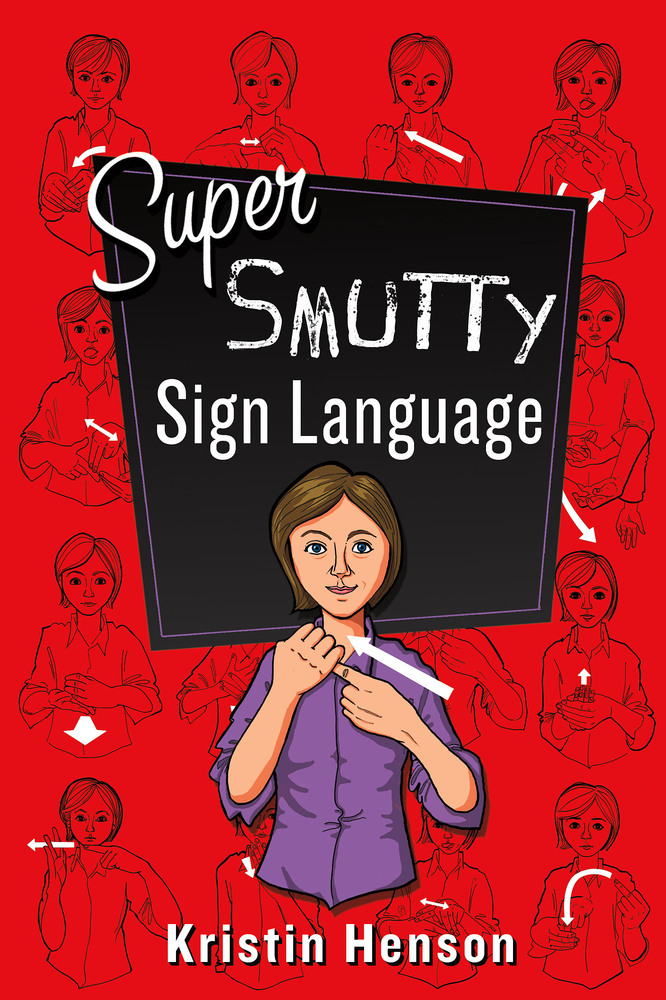
Super Smutty Sign Language Book


The book is out. The Super Smutty Sign Language book is now available on Amazon. Huffington Post is helping to advertise it, too. And, well, so what? No big deal there. Capitalism at its best. Unless you want to give more exposure to the author, Kristen Hanson, and her book sales then you could probably try and object in the Huffington Post's comment section along with about 40 positive comments vs some 126 one star review rating in Amazon's comment section with one positive comment coming from one person who actually purchased the book.
Everyone in the deaf community needs to relax and that's coming from a deaf person, me. I would wager none of these 1 star reviews have actually read the book.It's not YOUR language, you don't have a copyright on it, and you don't own it. All of you are the same ones who tried to stop the publication of this book with an online petition. How did that work out for you by the way? She's not deaf, yeah I get it. The phrases don't translate with 100% accuracy, ok fine. That does not mean she can't have fun with the language. I personally bought the book and I'm enjoying it, everyone needs to lighten up.
     
Back in July of 2012 there was a lot of drama over the author's intent on publishing her Smutty Sign Language book. A drama that went nowhere as you can see in their petitioning attempt.


Will the Amazon's poor review rating work?  Certainly better than ripping off deaf people of a book advertised to them and not telling them about the 200 blank pages that came with it. That was perhaps just as distasteful than anything else?  A matter of taste, I suppose, if not the measure of a person's own stupidity manifested in the form of a book. All blank and no intelligence.

Saturday, September 07, 2013

Genie Gertz - new Dean of Gallaudet University College of Arts and Sciences

Congrats to Dr. Genie Gertz on becoming Gallaudet University's next Dean of Gallaudet University College of Arts and Sciences. And I'm sure it's a step closer to her ultimate goal.

Gallaudet University's announcement on the news of hiring Dr. Genie Gertz with all the wonderful plaudits and coverage of her background experience when she was the Dean of the Deaf Studies Division at Ohlone College in Fremont, California. But there's an interesting omission in that announcement. It didn't say the one thing that Dr. Genie Gertz is well known which is her push for "Deafhood." And her strong ties with Ella Mae Lentz and the Deafhood Foundation, a non-profit, 501(c)3 organization (tax identification number is 26-2603125). And in turn Deafhood Foundation's strong ties with DBC and AFA who are basically their "shock troops" in terms of their activism or militancy (i.e. protest) against cochlear implant companies, AG Bell, John Tracy Clinic, Oberkotter Foundation, Hands and Voices, and so on. 

Their background and association:
Lentz and Genie Gertz, dean of the Deaf Studies Division and Special Studies at Ohlone College in Fremont, Calif., have led workshops for deaf adults around the country since 2005. Deafhood Youth Northwest on Tuesday at Mount Tahoma was their first presentation tailored to teenagers.
Tailored only to culturally deaf teenagers is what they meant.

These presentations, workshops or conferences (free or fee) were the "ASL-only" or "Deaf people only" types which meant no voice interpreters or sign language interpreters or any other accommodations provided such as CART. An overt display of practicing segregation, communication discrimination and even indoctrination in some cases. Never taking into account of people new to signing who may have difficulty in understanding in an ASL-only environment, those who may have language processing issues with sign language, or those who are deaf but do not know sign language and want to know more about their presentation but cannot due to communication discrimination. Or even for parents of deaf/hh children who want to understand better so they can make an informed decision regarding their child's education, language development and communication option. What is remarkable is to see how these workshops have practiced segregation and discrimination as you can see with these announcements below.

The flyer (click on pictures below to expand):


More presentation :


More pushing of Paddy Ladd's book and presentation:

More association with Deafhood Foundation.

More announcements:


Most recent flyer this year:


And other spinoffs:


Compare those announcements to that of the HLAA (Hearing Loss Association of America) announcement in the area of communication accommodation.


There are four things here to think about.

1) Indoctrination.
2) Communication discrimination - against those who may have limited sign language skills or have other communication preferences.
3) Segregation.
4) Exclusionary practices.

Dr. Genie Hertz is now working for Gallaudet University but here is a stark reminder for her.

According to Section 504,  Gallaudet University has an obligation to ensure accessibility to students with disabilities, including those with hearing loss and the need for communication accessibility because Gallaudet University is a recipient of Federal financial assistance as a post secondary institution.
An important responsibility of the Office for Civil Rights (OCR) is to eliminate discrimination on the basis of disability against students with disabilities. OCR receives numerous complaints and inquiries in the area of elementary and secondary education involving Section 504 of the Rehabilitation Act of 1973, as amended, 29 U.S.C. § 794 (Section 504). Most of these concern identification of students who are protected by Section 504 and the means to obtain an appropriate education for such students.
Section 504 is a federal law designed to protect the rights of individuals with disabilities in programs and activities that receive Federal financial assistance from the U.S. Department of Education (ED). Section 504 provides: "No otherwise qualified individual with a disability in the United States . . . shall, solely by reason of her or his disability, be excluded from the participation in, be denied the benefits of, or be subjected to discrimination under any program or activity receiving Federal financial assistance . . . ."
OCR enforces Section 504 in programs and activities that receive Federal financial assistance from ED. Recipients of this Federal financial assistance include public school districts, institutions of higher education, and other state and local education agencies. The regulations implementing Section 504 in the context of educational institutions appear at 34 C.F.R. Part 104.
Services students and staff should be able to request at Gallaudet University:

* American Sign Language Interpreter
* Signed English Interpreter (SEE-Signing Exact English or PSE-Pidgin Sign English)
* FM Systems and Conference Microphones
* Voice interpreter
* CART
* Remote Captioning
* Cued Speech Transiliterator
* I-Communicator
* Typewell/C-Print
* Professional or Volunteer Notetakers
* Tactile communication

Even though Gallaudet University obviously supports ASL many are calling for the exclusive use of ASL for all or ASL at all times. That'd be fine if the educational institution in question became a private educational institution receiving no federal funding then it wouldn't fall under the rules of Section 504.  But since Gallaudet University does receive annual Federal funding for as long as it has been opened it must abide by Section 504 laws.  Section 504 gives the power over to students who may request communication accessibility that fit their communication needs other than just ASL.

That's a stark but humbling reality there.

Since president Hurwitz of Gallaudet University supports the new ICED resolution which does call for pluralism and to "accept and respect all languages and all forms of communication," and that Gallaudet University must follow the laws under Section 504. The question today is will indoctrination continue at Gallaudet University?

Monday, August 19, 2013

Deaf/hh people, need an edge on getting a job?

For folks who live in the Kansas City, Missouri area:

Are you deaf or hard of hearing and need a better competitive edge on getting a job and retain it? A job that allows you to communicate in real time with 100% communication access with your hearing boss, supervisor, co-workers and even your clients or customers without the need of a 3rd party or sign language interpreter? Is there a job service that combines face to face communication technology for deaf and hard of hearing people? sComm, the maker of the UbiDuo whose CEO and co-founder is deaf, is proud to announce a new service called UbiJobs - workforce solutions for hearing, deaf, and hard of hearing job seekers.  If you live in the Kansas City metro area give UbiJobs a try, it could change your life for the better with a better competitive edge in a tight job market.

Wednesday, August 14, 2013

Deaf man mocks a "deaf" beggar

A recent video came to my attention of a Deaf man mocking a beggar at Las Vegas seen here in a Facebook video. This beggar was holding up a sign saying "Deaf. Hungry." Plus another word below which could not be read due to the blurry video.

Ted, the Deaf man signing in the video, made an assumption that the beggar could not possibly be deaf but hearing simply because the beggar did not know sign language.

Now, there are two possibilities.

1) The beggar could be deaf or hard of hearing and does not know sign language.

2) Or the beggar is hearing and does not know sign language.

Ted assumed the beggar is hearing on the basis he did not respond to Ted's signing to him. And thereby concluded the beggar is lying about his medical condition and not deaf at all.  But the beggar could have been born with a hearing loss or is a late deafened person who is homeless.

There are many deaf people in the United States who do not know sign language.
The majority of people who are deaf and hard of hearing do not know sign language. According to a Johns Hopkins study, more than 48 million people in the United States are deaf or hard of hearing, or a fifth of all Americans. Of these, almost 99 percent lost their hearing or were raised orally–not using sign language–and rely on their residual hearing (aided by hearing aids or cochlear implants), speech reading, and the printed word for communication access. This group of people are greatly aided by text forms of access.
Just because you see a deaf person does not mean the person knows sign language. Bad assumption. Best way is to get the facts first. If indeed the beggar is hearing, then shame on him. If indeed the beggar is deaf/hh, then double shame on Ted.  Either way, it's a bit disgusting to watch.


UPDATE: Good friend of mine, Barry Sewell and his wife, Crystal, produced their own captioned video about the disturbing video they saw in Facebook.

Sunday, June 02, 2013

"F*ck you, Deaf community!": Part II

Sometimes people who think they are doing the right thing actually end up hurting their cause and image when it comes to certain deafness related issues and concerns. I blogged this before a few years back and I think this warrant another blog piece in light of Daniel Winship's Facebook piece that generated lots of negative and positive reactions as a reminder that spewing hate and vindictiveness could simply backfire where targeted parents wrongly accused get the full wrath of the Deaf community's ire. Sometimes quite skewed in their outlook while other times sobering. The thread I'm about to link provide an insight look into the views and perspectives of mostly hearing people on the discussion of cochlear implant. It's a sobering read and seeing how many of them experienced the wrath from certain inner circles of the culturally deaf community their ire and hate. The author of the thread, Fuck you, Deaf "Community"   , is a hearing parent who exemplifies the very example of how the venting of the culturally deaf community can backfire in getting the very parents their support on the cochlear implant issue.


1. My 4-year-old daughter is deaf. She is not "Deaf" with a capitol D. She simply has no hair cells in her cochlea, she has no functioning inner ear. Even though she is deaf, she is not automatically part of your little world of shame and exclusion, and her native language is not ASL. It is not child abuse if we decide to raise her in a household that speaks English. So: fuck you for claiming her as your own, without a second thought to the wishes of her parents.

2. We gave our daughter cochlear implants when she was an infant. We made this long and difficult decision based on the research that was available to us, based on the educational resources available in our area, based on the nature of her deafness, and, yes, based on our own biases and desires. She had her surgeries before she was old enough to make the choice for herself, because to wait so long means to give her hearing long after her developing brain can make the best use of it. It is a well-known and long-researched phenomenon that pre-lingual implantation leads to vastly improved speech and hearing skills. But you call it child abuse. You call it cosmetic surgery on an infant, and more than once you called me a monster for it. It is not child abuse, to make complicated decisions about your kids without their input - it's called parenting. Nor is it cosmetic to give my kid a developmental boost. So: fuck you for heaping accusations of pre-lingual cosmetic surgery child abuse on me.

3. Our family is learning ASL, and have been since we learned our daughter was profoundly deaf. We will use sign as a second language, indefinitely. My wife is in school to become an interpreter. Nor do we believe in a purely oralist tradition; we acknowledge the importance of communication between deaf people without assistance. We get it, ok? We're committed. But because we gave our daughter cochlear implants, you automatically believe that we're out to destroy ASL, to destroy Deaf culture. You never listen to our reasoning, because what do we know? We're motivated by a desire to mingle in both worlds, and yet we're constantly scoffed at by the Deafies on principle. So: fuck you for your pernicious false dichotomies.

4. Speaking of false dichotomies: what the hell do you mean by the "Hearing Community"? You mean the 99% of the world...with functional ears? They form a single community separate from your own? Because obviously it's the Deaf Community vs. the world. Yeah, fuck you and your false dichotomies, again.

5. It's funny how your handicap isn't a handicap. You aren't missing a major sensory organ, it's simply that you have chosen a primary language which is signed rather than spoken. You embrace and welcome the nature of your language and your community, and you are, you say, just as capable as any hearing person. I get it - it's not a handicap. It's not a disability. You feel that there's nothing wrong with your bodies. You aren't broken machines in need of repair. You're not incomplete people deserving of pity. You're a close-knit community because, I gather, there's a conspiracy of doctors and audiologists and educators and academics and hearing-aid industry types, who are, to a person, out to suck your wallets dry then utterly crush and humiliate you, simply because...they hate your lifestyle choice. But you look past all that. You're complete and beautiful human beings and you're happy with the way God created you. There's nothing wrong with being deaf. Deafness is beautiful! So fuck you for demanding - and happily accepting - constant special accommodation for your alleged non-handicap. (And fuck you for demanding respect and understanding from my family, without giving us any in return.)

6. Your precious ASL doesn't have a sweet simplicity; it's just as capricious and arbitrary and fucked-up as any other language. I mean, come on! In our current class, we're learning three - THREE - different signs for the word "car". Which you don't apparently use interchangeably. What the hell? It kind of messes up your principle of "conceptual accuracy". Especially considering that there are many signs for most common words. A lot of the difference is regional, but a lot is just "we do it this way, they do it that way". ASL is, simply, fragmented. English, at least, has standardized on "wh" question words: "who", "why", etc. But English, even in signed form, is "too ugly" for you. Fuck you and your "beautiful language" high horse.

7. ASL purists, who want to distance ASL from English as much as possible, who advocate removing as much fingerspelling from the language as possible, who want to remove as many initial letters ("T" for toilet, "B" for box, etc.) as possible... yeah, I see you fingerspelling common words, I see you happily using intial letters. Fuck you for...well, for being uppity elitists. Go drive a Hummer while you're at it.

8. ASL has no written form. It must use another language - the hated and maligned English - for written communication. Therefore, it's nigh-impossible to look up a new word by its sign. Therefore, memorization plays a much larger role in ASL than in most languages. Therefore, more effort goes into learning how to sign, when other kids are learning how to read and write. Guess what kind of impact that has on illiteracy rates? And...you seem to prefer it that way? Before I met y'all I thought the illiteracy was the result of educational and developmental difficulties. But the more Deaf people I meet, the more I find that you don't much care about reading and writing proper English. ASL and TV is all you need. So...yeah. Fuck you for that, too. By the way, my deaf daughter is learning how to read, you dipshits.

9. While I'm at it, Alexander Graham Bell has been dead for 86 fucking years. When he was alive, he didn't gas any Deaf babies, he didn't sterilize anyone. If you honestly believe that he wanted to prevent deaf people from reproducing, even when his mother and wife were deaf, then I honestly believe you're pretty damn stupid. At any rate, it's a vastly different world today than it was back then. Believe you me, there are plenty of other villains to worry about today. Fuck you for not getting over A.G. Bell already.

10. Again with the calling me an audist in denial of your beautiful heritage. Which is funny, because from my perspective, you're being "deafists" in denial of your own handicaps. But you don't see me calling you out on it several times a week. Fuck you and your utter lack of tact.

But mostly, fuck you for putting a claim on my kid. I've been at this for more than four years, and you're just getting more hostile at us hearing-family-with-deaf-child-who-has-cochlear-implants. Our world, the world of the hearing, the world we're raising our girl in, the world you loathe so much -- our world is fucked up, sure, but it's roses and cotton candy and day-long free pony rides compared to yours.

Saturday, June 01, 2013

CAD and the AB 455 California Bill

The AB 455 bill is looking more like a bill that needs to be thrown out because it lacks an official definition for the term "Deaf" seen here in the bill. Unless the bill can provide an official definition to the term "Deaf" then perhaps the bill can be saved rather than scrapped.

But there's a problem.

The confusion could be blamed on zealots who wanted to change the definition of the word "Deaf" with the capitalized "D" to mean all inclusive of those with a hearing loss from mild to profound, whether they know sign language or not.  In fact, you have people like Dr. Genie Gertz, Ella Mae Lentz, and  others who are in the same boat and would even agree with what Dr. Grushkin said,
I choose to capitalize "Deaf" for all Deaf (and Hard of Hearing) people, not to signify any cultural affiliation, but to emphasize the common ethnicity of Deaf people. I believe that the d/D distinction is unnecessarily divisive, cumbersome, and ultimately more trouble than it is worth, although it did serve an important purpose in its time. But using Deaf for all does not signify cultural membership, just as not all Black people are necessarily part of Black culture or all Jews are practicing religious Jews.
And compare that to the official definition of "Deaf" according to Carol Padden and Tom Humphries, in Deaf in America: Voices from a Culture (1988) who invented the capitalized, big D, word explains the meaning and difference between "D"eaf and "d"eaf:
We use the lowercase deaf when referring to the audiological condition of not hearing, and the uppercase Deaf when referring to a particular group of deaf people who share a language – American Sign Language (ASL) – and a culture. The members of this group have inherited their sign language, use it as a primary means of communication among themselves, and hold a set of beliefs about themselves and their connection to the larger society. We distinguish them from, for example, those who find themselves losing their hearing because of illness, trauma or age; although these people share the condition of not hearing, they do not have access to the knowledge, beliefs, and practices that make up the culture of Deaf people.
In short, the term "Deaf" has always been defined as people who are culturally deaf and signs in ASL. That already defined word has already entered into the collective conscious minds of people for almost three decades. But people have a nasty habitat on putting the term "Deaf" into a bill or a bylaw without providing an official definition as a clarification.

California Association of the Deaf bylaws is another good example who used the term "Deaf" peppered throughout but no definition explaining the meaning "Deaf." Yet also, their bylaws make no reference to the term "hard of hearing," either. They didn't write down "Deaf and hard of hearing" in their bylaws like the AB 455 bill did but used only the  "Deaf" term instead. In other words they made the term "Deaf" to mean all inclusive those with a hearing loss from mild to profound rather than to mean only for culturally deaf people.

 At the very bottom of the bylaws CAD has a definition of the term "Deaf":
"Deaf is a term that includes all the individuals: born deaf, deafened in early, sometimes late childhood, for whom American Sign Language and Deaf community/culture collectively represent their primary experience and existence regardless of hearing disability they have.”
Was that an official definition of "Deaf" from CAD? Curiously so in their most recently updated bylaws as of August of 2011 they presented no definition for the term "Deaf" in various forms such as "Deaf community," "Deaf individuals," and the single term "Deaf."

Over the last three decades Deaf (culturally deaf) people have made a point that they "own" the word "Deaf" and for it to mean explicitly one thing, a deaf culture group that uses ASL. They have always agreed with Padden and Humphries' definition of that term.
Deaf with a capital D is a cultural term, rather than an audiological one. As defined by Carol Padden and Tom Humphries in Deaf in America: Voices from a Culture (1988), Deaf refers ‘to a particular group of deaf people who share a language—American Sign Language (ASL)—and a culture.”
Hence, it's understandable seeing the confusion of the bill's language writing in "Deaf and hard of hearing" into the bill when earlier it was written as "deaf and hard of hearing."  Exactly what is the official definition of the term "Deaf" seen in the AB 455 bill?

Well? What is it?

I'm waiting.

UPDATE: Of course, this is something that Tara Congdon failed to realize in her "investigative" reporting on CNN that the bill lacked any definition for the term "Deaf" which might become the unexpected monkey wrench. We'll wait and see, and get a more definitive report elsewhere whether the bill might present a problem or not.

Saturday, May 11, 2013

Deaf staff bullying others at ASDB?

Where is this "I am - Fiver!" when you need her or him around (see near bottom of page)?

If this bullying actually happened then this would be the first known example of Deaf teachers or staff bullying others in the effort to get him or her in trouble by making up nonsense stuff. The practice of instilling fear into those who have alternative opinions or beliefs when it comes to deaf education, mode of communication and language development. Here's one hard of hearing staff or teacher at the Arizona School for the Deaf and Blind, who may have worked there at one time, recalled his time the going ons while working at ASDB as seen in the comment section of the Arizona Daily Star reporting on the  explosive ASDB story.
Working at ASDB not being in the in crowd, everyone watches you and reports silly crap to your supervisor. I know I was good at my job, but I allowed myself to be pushed out because going to work in a hostile work environment everyday is not healthy. Being watched and being called into your supervisors office everyday for petty stuff becomes old and tiring. I look back now and wish I would have went and talked to Robert Hill, but Nancy A. would have probably told the deaf community and I would have hell to pay.  
Bullying some of the teachers and/or staff as well as bullying hard of hearing students at ASDB? Have these incidents actually taken place at that school? If so, then it's a disturbing revelation.

Do you recall one anonymous commenter from two years ago under the pseudonym "I am Fiver!" who proclaimed to be "the most dangerous threat to their (Deafhood) plans" and discussed the idea of this so-called "assimilation" plan?
Shel has been the most vociferous with her attempts to rationalize these methods that are oppressive to those children with residual hearing and speech that can be developed. The “bi-bi” approach, or rather “movement” is operating under the guise of “teaching language and culture.” This implies that ASL and Deaf culture are only incidental to the teaching, when in fact, those concepts are the main goal. Auditory methods and speech articulation are suppressed under the rationale that it is necessary in order for these children to “assimilate” ASL to proficiency. There are many fallacies regarding this assumption. But just bear in mind that these people are profoundly affecting the lives of these children by altering the primary language to ASL and by exposure to a culture that has not been defined.

There is no theory or empirical evidence that ASL is a “bridge” to English language learning, even though this very premise has been claimed by many renowned (unnamed) educators of the deaf. In the past these advocates for “bi-bi,” ASL, etc. have alluded to, or insinuated that such a thing exists. But when pressed, they admit that there is no evidence. This has not stopped them, however. They are fervently working to manufacture “studies” and seeking out established language experts to validate their methods, by claiming parallels about how hearing persons learn foreign language. It is not the same! Learners of a second language have already acquired their primary language!

The goal of our schools, whether they are public schools for the hearing or public (state schools) for the deaf, the majority of states require that English must be taught as L1 (English=First Language). This is not happening in deaf schools where ASL is being taught as L1 (ASL=First Language). In such cases, this is clear violation of state law. Children must be taught English in order to function and be economically viable in the world, once they leave the school. I suppose, I do not know, but suppose, that they will rationalize their actions by saying that deaf require a visual language in order to communicate. All that they are doing is engraining these children into a language that is little known or used outside of deaf circles.

The minds of young children are “in the process” of being wired in early childhood. Although much of this “wiring” occurs in the first 2-3 years, it continues for many years after this “ideal window” for language development. Once a child is “wired” for a language of a certain type, that mode becomes life-long and unlikely to change. Proponents of the “bi-bi” movement know this, and are pressing forward with this misguided approach that will create a whole new generation of deaf individuals bereft of English language skills, recognizable speech, and enculturation into an extremely small minority “society” that has historically, and likely to remain a social and economic under-class in perpetuity.
Sounds like this "Fiver" person is somebody from the inside of ASDB or was on the inside or at another deaf school. At least the person appears to know a lot more details than he or she would care to share. Is this really about regaining a sure toehold on the whole indoctrination process the reason behind the constant bullying, if true, and the taping of a hard of a hearing student's mouth for talking in class, if true? Then perhaps once the investigation into these allegations on both sides at ASDB gets done it might shed some light on the veil of secrecy among the staff and the going on. Then again we might not get to the bottom of this. But one thing for sure, it won't be pretty once the investigation is over. 


Saturday, May 04, 2013

Remember AB2072...?

Remember AB2072?  That was three years ago when the brouhaha started.

Remember the veto of that bill and the reason why?  Refresh your memory here.  And how that bill could have created a path to have a California law recognizing ASL as a valid option for language and communication access?

Remember how happy those culturally deaf protesters were when AB2072 was vetoed by the governor of California?

Do you also remember in the AB2072 bill it referred to California's Department of Education as one of the multi-agency that support the Early Start Program?  And how they would provide a packet of information on "Communicating with Your Child" with information about local, state and national resources and how the Dept. Health Care Services web site provides links to local, state, and national resources regarding deaf and hard of hearing children as stated in the bill ?

Remember in 2010 the year when AB2072 came out in California the Department of California did not have a position statement on language access for students who are deaf and hard of hearing? Do you realize that the CDE has now posted their position statement on their website two days ago?

Do you realize in their position statement what the Department supports in terms of language and communication access?
Recognizes and respects the right of parents of children who are Deaf or Hard of Hearing to make informed decisions about the language(s) they will use in raising their children.
and
Recognizes and respects the right of parents of children who are Deaf or Hard of Hearing to make informed decisions about the communication tool(s) they will use in raising their children.
and more importantly on the choices,
Believes that parents should not be compelled to choose between spoken and signed language. They may choose to use both.
Remember those who were against the AB2072 bill stated their reason why?
The opposition argues that the focus of this bill about "communication options" is misleading and picking one option over another would only rob the child of the ability and opportunity for full language acquisition.
Do you want to read California Department of Education's position statement on language access again on the parents' right to make an informed decision regarding their deaf or hard of hearing child on language choice and communication access?

Remember how happy those deaf protesters were when AB2072 was vetoed the one opportunity on creating a path to have a California law recognizing ASL as a valid language option as a beginning foundation? How does that reconcile with the fact today that CDE now supports the right of deaf and hard of hearing children to have early access to a complete language, visual OR spoken, from birth? This mean CDE would support a deaf child with a cochlear implant or a hard of hearing child with a hearing aid to have early access to the spoken language only. Or that a child can visually sign in SEE. Even CUED speech would be a valid option. CDE position statement does not say they support early access to a complete visual language (i.e. ASL) which is what NorCal wanted in the first place.  Instead, CDE supports early language access either visual OR spoken, OR both.

Here's the funny thing if not ironic by now was that in the beginning the Deaf Newborn Identification and Advocacy (DNIA) strongly recommended changing the Newborn and Infant Hearing Screening program by putting the Early Start under the California Department of Education.
Early Start should be under the state entity that is best fitted to provide oversight and coordinate early intervention services: The California Department of Education (CDE). The Department of Developmental Services (DDS) should not be involved at all, unless a child in a particular case is developmentally disabled.
And
The CDE should be the entity responsible for designing an appropriate resource guide-handbook...
The DNIA states that ASL should only be the first option from the start along with reading and writing English with an emphasis on shifting away from the ear and the spoken language (i.e. aurally and orally) and that they are to be secondary in a deaf or hard of hearing child's life. But the CDE,
Emphasizes that the purpose of Early Start for children who are Deaf or Hard of Hearing is to ensure that these children acquire age appropriate language skills to enable them to do well in school and career.


Nothing is said that ASL should be the language of choice for deaf or hard of hearing children but rather that the language could either be spoken OR visual, OR both as determined by their parents when they make their informed decision.

How does it feel to have a hole in your foot now that California Department of Education has solidified their position on language access for students who are deaf and hard of hearing, and Early Start?  Sounds like both CDE and DDS are very much in the same camp regarding their positions and philosophies for deaf and hard of hearing children.

Ain't that wonderful?

Sunday, April 28, 2013

The power of captioning for deaf/hh organizations

I see this again and again the lack of captions in videos by organizations that serve the deaf and hard of hearing community, and even for parents of deaf and hard of hearing children. The lack of captions or subtitles is actually quite prevalent which makes the whole situation an awkward oxymoron of sorts. You'd half expect a transcript be available if captions or subtitles aren't available but that end up missing, too.  Really, for an organization, how hard can it be to include captions?  For any organizations worth its salt would have the common sense and smarts to make sure all of their videos are captioned.

Why do some deaf/hh run organizations cannot include captions or subtitles in their own videos in their effort to get the message out?  There is NO TRUTH at all for a non-captioned (and no transcript) video in getting the message out to the larger society who either cannot hear well to understand the spoken words completely or do not know or have trouble following sign language. If an organization want to build a bridge make sure the span crosses completely the communication chasm by including captions and/or transcripts (must remember the deaf/blind people out there, too!). By not including captions/subtitles the message will simply spin on its own going nowhere. It'd be even worse if the message only stayed within a certain deaf/hh community when the intent was to get the message out.  How can that happen if videos are not inaccessible to the majority of the population? Why practice hypocrisy and commit the same communication oppression?

Bottom line, organizations that serve deaf and hard of hearing community have a better chance in getting the message out if their videos are captioned. Otherwise your "truth" will simply go nowhere. A wasted time and effort.


The Walking Effect

The difference between Walk4Hearing and Walk for ASL?

Walk4Hearing involves the community on a much larger scale with thousands of people every year in 22 different cities from June through October. The local media reporting in each city help generate more public awareness about hearing loss. It's a public relation dream machine. Walk for ASL on the other hand involves 15 culturally deaf people who will walk for 30 days from San Francisco to Santa Monica, California with the hope that their actions and message will capture the attention of the media.

Walk4Hearing is again raising money and has a very successful formula since 2006 because approximately 1 out 8 Americans with hearing loss have something that they can relate to each other with a common condition. There are many more hearing parents, friends and families who know someone with a hearing loss.  It could be their grandpa who experienced hearing loss later in his life. Or have a deaf or hard of hearing brother or a sister. A parent with a hearing loss. A hearing person whose best friend wears a hearing aid. A next door neighbor whose teenager experienced hearing loss from Meningitis.  Hearing loss is such a common condition in the United States the majority of the population are familiar with it. And because of the familiarity about hearing loss they become much more approachable about auditory-oral education, hearing aids, cochlear implants, or implantable hearing device that uses the eardrum as a natural microphone. No wonder auditory-oral schools are succeeding in their public relation efforts with their communities.

In its first year in 2006 the Walk4Hearing raised over $300,000. Since 2006 they have raised several million dollars. In 2011 Walk4Hearing successfully raised $1.1 million dollars in a matter of months. In 2012 they surpassed the $1.2 million dollar mark. This year their goal is to raise $1.4 million dollars and so far they are 24% of their goal with $336,000 raised already and they are on track to surpass the $1.4 million dollar mark before the first walk to start in June of this year.

Money raised is shared between national and local programs and services including support of children with hearing loss at www.kidsandhearingloss.org.

National Programs and Services    
  • Provide timely and reliable information about hearing loss through HLAA’s website, Hearing Loss Magazine, HLAA e-News, the Hearing Loss Support Specialist Training, message boards/chat forums and annual conventions
  • Advocacy at the national level to affect legislation that impacts people with hearing loss, whether it’s funding for hearing aids, cochlear implants, communication access in public places or other important issues
  • A nationwide network of chapters and state organizations providing peer support
  • Support for parents of children with hearing loss at www.kidsandhearingloss.org
  • Outreach to veterans returning with hearing loss
  • Social networking site for young adults with hearing loss at www.hearinglossnation.org
Local Programs and Services    
  • Captioning and hearing assistive technology at HLAA chapter meetings to make them accessible
  • Scholarships toward college tuition for students with hearing loss
  • Funding for hearing aids and assistive listening devices for people who cannot afford them
  • Installation of hearing assistive technology in public places, such as community rooms and public libraries
  • Captioning of live theater productions
  • Seminars on coping with hearing loss
The www.kidsandhearingloss.org website is to help
empower parents of hard of hearing and/or deaf children by providing the resources necessary for them to make informed decisions about their children’s hearing loss.
Below is a Walk4Hearing video promotion with subtitles.


Walk for ASL is a new venture idea to help raise awareness and seek funding for their own agenda and cause. It only actively involve 15 deaf people who will walk in California the 600 miles from San Francisco to Santa Monica in 30 days along the Pacific Coast Highway. Their goal is to get the attention of the media.

The difference here is that ASL and deaf culture are essentially a hidden language and community. They are more apparent in large cities such as Washington D.C.; Rochester, NY; Seattle, WA; and Austin, TX. Even in large cities the bulk of hearing people go about their daily lives and never get to meet or see a signing deaf person in their life. And for a good reason because the culturally deaf community make up about 0.2% (0.002) of the total population in the United States. The chance to meet a signing deaf person or a deaf group would be quite small. It becomes harder for hearing people to even sympathize with such a small deaf community when they try and raise awareness on ASL, a language and culture that are totally foreign to most of the hearing society. They might hear about signing deaf people in the news on rare occasions or by chance see a deaf character in a television show. But to the hearing society the language and culture of deaf people are still completely foreign to them.

Below is a Walk for ASL video promotion but no subtitles or transcript available.


Saturday, April 20, 2013

Using your voice at Gallaudet University and elsewhere is OK


There were several instances of a protest supporter, student, faculty or alumnus who used his/her voice (without signing) in front of hearing, deaf, and  hard of hearing audience. Most of these people who used their voice instead of signing were either deaf or hard of hearing at places like Gallaudet University and the Senate Health Hearing in California on the AB2072 bill. In all cases there were sign language interpreters available and in some cases included voice interpreter and real time captioner.  This is about respecting communication preferences of deaf and hard of hearing people. A preference that they feel most comfortable in. Due to certain circumstances sometimes voice had to be used instead of signing.

Before I get started I want to remind people that Gallaudet University is a true, bi-lingual institute. I would like to think students attending Gallaudet University are not linguistically disabled in the English language, especially towards the end of their undergraduate career with a strengthened English competency and literacy.   I see both the English language (spoken or written) and sign language as equally supported on campus. Both ASL and the spoken English language deserve equal respect in the cases I'm about to present.

Secondly, I must remind people that president Hurtwitz of Gallaudet University re-iterated a key point that ICED issued a global call to "accept and respect all languages and all forms of communication" in the education of deaf and hard of hearing people. There were no restrictions or specificity against the use of Cued Speech, oral-auditory methods, SEE, PSE, AVT, note takers, CART, captioning, texting, voice to text, use of hearing aids and cochlear implants to help communicate and listen, and so on. Nor did ICED specify or condemn for using one form of communication method over another. Nothing was said about which form of communication MUST be used but rather that all forms of communication MUST be accepted and respected.

Did you get that?

Thirdly, as a side note, most students on campus do not sign in "pure ASL" but instead mouth the words while signing almost or completely in English word order like a PSE or signed English format. Some do sign and use their voice at the same time like former interim president Robert Davila of Gallaudet University as you can see (and hear) in the video below at time stamp from 1:13 to 2:01. Also note in the video on how deaf/hh people sign and mouths the words at the same time and oftentimes in English order. Pure ASL? Not really.


Moving on.

 
The first notable so called "scandal" that I'm aware of took place at Gallaudet University in 2006. Dr. Brenda Brueggemann, who is deaf, was the Commencement Speaker for Gallaudet University's graduating class of 2006.  She used her own voice instead of sign language.


She was at the time the interim Acting Chair of the Gallaudet University Board of Trustees. She was essentially pushed to take over Celia May Baldwin's position after she suddenly resigned claiming threats were made against her by some nutty pro-DPN2 protesters.  After the 2006 Gallaudet University graduation ceremony Dr. Brueggemann was wrongly attacked for using her voice.  The attackers simply did not see the bigger picture the reason why she had to use her voice in the first place as explained to me by Bruggemann in her email to me in 2010.
Meanwhile, I do also completely understand the reason and "right" for using ASL more and "better" --especially at places like Gallaudet. My ASL is only about half-good right now--not even as good as my German probably. But I can have conversations. I did so all the time as Board Chair with King and other Gu administrators directly on VRS (not using interpreters). I get by. And had I had any time to actually prepare my remarks for the GU graduation last May, I probably would have signed them more or at least part of them. But I didn't have that prep time. I was dropped into the Acting Chair's position on May 10, to be exact--once CM Baldwin resigned. And I was handed the remarks she was supposed to deliver (already scripted) for graduation on May 12. In fact, they didn't even give me the script until the morning of May 12. And it still had her name at the top of it! So, using oral/spoken English, I could feel comfortable enough to develop a few of my own "touches" in the prepared script. But I sure couldn't do that trying to use ASL....
If only the attackers knew about the little known history of why Dr. Brueggemann used her voice then they would not have screeched themselves into an apoplectic fit.   Instead, they get eggs on their faces just like Random Thoughts and Musings by moi blog who got everything wrong about Dr. Brueggemann's reason to use her voice that day.

Feeling silly right about now, don't you?

Let's keep an open mind here, folks.  Signers have a different level of fluency and visual reception/recognition. Not all deaf or hard of hearing people know sign language.

Dr. Brueggemann gave me a poignant but funny message in her email to me to share with everybody:
"Hey, I like my voice!" I'm proud of it. It's unique, it's mine, I like it. I think I'll use it! - Dr. Brenda Brueggemann. Sept 1, 2010.
Yeah, me, too.

The second "scandal" occurred around November of 2009 when a hearing doctoral candidate at Gallaudet University presented a dissertation defense in spoken English rather than ASL to a diverse audience of deaf, hard of hearing and hearing students as well as professors. Gallaudet University provided ASL interpreters. That "scandal" was short-lived, too.  Not much details other than it happened. Although I do admit this has nothing to do with a deaf or hard of hearing person but it was the idea that a doctoral candidate was allowed to use his own voice to speak in his dissertation defense at Gallaudet University.

Then we have an unknown person named "Bobby W" who claimed to have used his voice in 2006 to defend his student teaching experience for his degree at Gallaudet University:
If it makes you feel any better at the height of the campus scandal in 2006 while I was defending my student teaching experience for my degree from Gallaudet in front of the Education Department. I also choose to use my voice to do so. I used ASL for the answering/question session but the actual defense I used my voice. Imagine defending an education degree from Gallaudet University orally. I'm sure I was the FIRST to ever do so.

I received a few funny looks from my peers and a few of the EDU professors but It was a success...

-Bobby W.
Bobby W, where are you? Are you deaf, hh or hearing?

Next, of course, you have another Gallaudet University alumnus, which would me, who used his voice to speak at an audience at Gallaudet University's first ever vlogging/blogging conference in 2007.  I was one several panel members at that vlogging/blogging conference.  It was streamed in live in front of an internet audience and those physically present. Most people, I think, were quite receptive of my decision to use my voice based on the comments I received compared to Dr. Brueggemann's who probably got more people their panties in a bunch.  I don't think mine counted as a "scandal" by any stretch of the imagination.

And then we had this culturally deaf guy who was the Sacramento chapter president of CAD used his voice at the Senate Health Hearing in California in a room full of culturally deaf people which easily outnumbered the number of hearing people present. It's not a scandal if a deaf person choose to use his or her voice to speak or use sign language. The deaf and hard of hearing community support those who have a different but preferred mode of communicating.  You can find the original video of Tim Riker and others at the Senate Health Hearing in here.  


But the real eye-brow raiser was when Tim Riker criticized another oral deaf person, John Fortias, for having "unintelligible speech. " The sad thing is that the "unintelligible speech" claim is not true at all. John's speech is intelligible as evidenced in a transcript and by the interpreters in both videos (see above and below). It is quite evident that a sign language interpreter could understand John's speech as evidenced in the video below (video source).


The message?

If you're deaf or hard of hearing, whether you wear hearing aids, cochlear implants or none at all, it is alright to use your voice to speak in a public setting as long as other modes of communication are accessible to those who cannot hear, have trouble understanding the spoken word or unable to understand a different language such as ASL.  Let's hope students and faculty members at Gallaudet University will not shame students for using their voice as a choice.  After all, Gallaudet University is a bi-lingual institute.  Don't let people bully or chide for your preferred communication choices.

Thursday, April 04, 2013

Deaf Schools similar to Hogwarts?

I saw Amy Cohen's link to a video in Facebook of Michael Stultz, an ASL teacher, who did a video explaining to his hearing students on what deaf schools are like. In a moment of inspiration he used the Hogwarts school that Harry Potter and his friends, and their enemies, attended as having that similarity. Mr. Stultz explained that Hogwarts and deaf schools have similarities such a having a cafeteria where students would come together and meet and eat, dormitories, classroom settings, and even sports or contests settings, and a place where self-identity would be realized. Although I'm wondering if deaf schools would include Gallaudet University as the final place for  "advanced wizardry students" to attend and graduate?

Seeing the video title I wondered who Lord Voldemort would be while I watched the video. Of course, I wasn't surprised when Mr. Stultz targeted AGBell and other oral schools as being the "Lord Voldemort" equivalent although never mind the fact that Lord Voldemort is a character and not an institution in the Harry Potter books/movies. Does teaching ASL includes teaching students on what to think about AGBell and other oral schools?

Just wondering.

Mr. Stultz gave an example of how "Voldemort's" goal would be to eradicate the Muggle born (not born into pure blood of wizard parents) and their kind of wizardry (which happens to be the good kind and used for good and not fall prey to the dark magic like Voldemort did - aka Tom Riddle). In other words, Mr. Stultz made the claim that the ultimate goal of AGBell and other oral schools (so called "Voldemort") would be to deliberately eradicate the culturally deaf community (so called "Muggles").

Desperate are we?

Problem number one. Lord Voldemort is Muggle born, too, but believe in blood-purity even though he became the most powerful and feared half-blood Dark Wizard. Dumbledore explains the blood-purity complex and problem that Lord Voldemort and other arch enemies of the dark magic believe in.
Dumbledore asserts that the much-vaunted blood purity does not exist, and is only a fiction maintained by the deceptions of supremacist wizards.
At Hogwarts they have their pure-bloods, too, like Draco Malfoy and others in the House of Slytherin. So, that's problem number two.

The pure-bloods are those born to wizard parents with many of them believing on mixing only with their kinds (e.g. nth generation family of pure blood, no miscegenation ). Examples of pure-bloods and what they do in order to maintain their "blood purity" lineage would be the Blacks, the Lestranges, the Crouches, the Fudges, the Gaunts, the Longbottoms, the Malfoys, the Potters and the Weasleys but not all of them believe in mixing only with their kinds like what the Malfoys believe (pay attention to the underlined bold below).
To maintain their blood purity, supremacist families have been known to inbreed into their own families by marrying their cousins, resulting in mental instability and violent natures. The Gaunts displayed both tendencies by the time of the sixth book with the exception of Merope, the last female member of the line.  
Pure-blood supremacists believe blood purity is a measure of a wizard's magical ability – notwithstanding examples of highly skilled Muggle-born witches like Hermione Granger and Lily Evans, and less skilled pure-bloods such as Neville Longbottom – and Muggles to be low-life, having no magic in them. Supremacists apply the term "blood traitor" to pure-bloods who harbor no prejudice against non-pure-bloods (enjoying their presence and relations with them).  
The antagonistic wizards in the Harry Potter books are almost all supremacists, while Harry and his friends disagree with this ideology. Rowling draws several parallels between the pure-blood supremacists and Nazi ideology in Harry Potter and the Deathly Hallows (the belief that pure-blood wizards have the right to subjugate the Muggle world and view themselves as a "master race", laws requiring Muggle-borns to register with the Ministry of Magic, rounding up Undesirables, etc.).

Sounds familiar? Traitors of "pure-blood" in the deaf sense would be culturally deaf people who enjoy intermingling with deaf/hh people of AGBell and those who are products of oral or even mainstreamed schools.

Who would the "pure-bloods" be if Michael Stultz is determined to use Voldemort and Hogwarts as examples?  Since "pure-bloods" are those wizards born to wizard parents sound very much like culturally deaf people born to culturally deaf parents and are a part of the "nth Deaf Generation." Those "pure-bloods" sometime advocates "Deaf purity" in all aspect of their Deaf life such as no hearing aids or cochlear implants coinciding with their own elitism of having been born, if they are lucky, as the nth culturally deaf generation who associate mostly with "their kinds" like other culturally deaf friends and families.

Deafhood anyone?

You see the problem now? The "pure-blood" at deaf schools would be the "nth born culturally deaf" students who do not wear or believe in hearing aids or cochlear implants, does not talk or do the "yowling" and use ASL only as their primary mode of communication. The "pure-bloods" at Hogwarts believe that Mugglehould not be taught magic and wizarding skills who limit their interaction with them by marginalizing them in many aspects of their lives.

Does that not sound familiar already? Do you see where I'm getting at?

Does the pure-blood Malfoys sound familiar, too?

Who would the "Deaf Malfoys" be at Gallaudet University and other (signing) deaf schools if you *really* want to go that far, Mr. Stultz?  Who would be the "Deaf Potters" be at Galluadet University and other deaf schools? What about the Longbottoms and the Weasleys who do not believe in the blood-purity requirement?

This gets worse (or better depending on your view).

Michael Stultz's attempted to compare (signing) deaf schools to that of Hogwarts using Lord Voldemort (aka Tom Riddle who is the ultimate character villain of Harry Potter) to represent AGBell and oral schools presents a number of problems as you can probably already see it by now.

Not everybody who attended Hogwarts were Muggle borns. You had the Malfoys, remember? The same pure-blood Draco Malfoy who sneered at Muggle borns at Hogwarts by calling them derisively and derogatorily as "Mudbloods."
Harry first encounters Draco's snobbish bigotry after their initial encounter at Madam Malkin's.[2] Rowling uses the Malfoys to introduce themes of intolerance and bigotry into a setting where people are often judged solely by their blood lineage rather than their good character or accomplishments. Draco, adhering to his family's beliefs, thinks that Muggle-born witches and wizards, which he and other characters derogatorily describe by the epithet Mudbloods, should be denied a magical education. Harry's first impression that the Wizarding community is a "magical wonderland" is instantly shattered. Says Rowling, "[Harry] found out that many people in power in the wizarding world are just as corrupt and nasty as they are in our world." Malfoy was originally named "Draco Spungen" in the earliest drafts of Philosopher's Stone. "Spungen" also appeared on her pre-canon class list, but it was crossed out and replaced with the surname "Spinks", while "Malfoy" was later added after the completion of the list. Philip Nel believes that Malfoy is derived from the French phrase mal foi, meaning "bad faith."In an article published in 2002, Nilsen and Nilsen argue that "Draco" has connotations with draconian, and that his name starts with "mal", a French prefix for "bad" or "evil". Many of Draco's relatives on his mother's side of the family (the Blacks) are named for stars or constellations (e.g., Sirius Black, Regulus Black, Andromeda Black Tonks, Bellatrix Black Lestrange, Cygnus Black, Orion Black). Another constellation is Draco (the Dragon). Draco Malfoy eventually named his son for yet another constellation, Scorpius.
Again, sound familiar?

In Hogwarts there are four Houses in the school of witchcraft and wizardry: Gryffindor, Ravenclaw, Hufflepuff, and Slytherin. Prior to starting school the Sorting Hat identifies each new Hogwarts student by wearing the hat. The Sorting Hat would either identify the new student belonging either to  Gryffindor, Ravenclaw, Hufflepuff, or Slytherin House,
The Sorting Hat claims that blood purity, is a factor in selecting Slytherins. This suggests that it bases its decisions more upon the views of its members than on any accurate test of a student's lineage. Muggle-born Slytherins exist, but are very rare, as noted insultingly by Scabior the Snatcher.[9] There have also been definite examples of half-bloods sorted into the house, including Tom Marvolo Riddle (Lord Voldemort) and Severus Snape. Harry Potter was nearly sorted into Slytherin, but ended up in Gryffindor instead.
So, what is the House of Slytherin?
Slytherin is one of the four Houses at Hogwarts School of Witchcraft and Wizardry, and is traditionally home to students who exhibit such traits as cunning, resourcefulness, and ambition. Its emblematic animal is the snake and its colours are green and silver. The house ghost is the Bloody Baron. Founded by Salazar Slytherin, the house is composed mostly of pure-blood students, due to its founder's mistrust of Muggle-born witches and wizards. Slytherin house has a negative reputation, with many claiming that it is the source of most Dark Wizards in Britain, notably Tom Marvolo Riddle, a.k.a. Lord Voldemort, as well as many of his Death Eaters (followers). It has a traditional rivalry with Gryffindor.
The Sorting Hat selected Gryffindor House for Harry Potter who noted for his good character and strength rather than for his blood purity. The Sorting Hat almost put Harry Potter into the House of Slytherin. And if you remember the movie Harry Potter was praying/hoping that he wouldn't want to be put into the House of Slytherin. The Sorting Hat explains what a Slytherin would do :

Or perhaps in Slytherin,
You'll make your real friends,
Those cunning folk use any means,
To achieve their ends.
"


- "Harry Potter and the Sorcerer's Stone" by J.K. Rowling        

The Slytherins will use any means to achieve their ends and that means cheating, killing, lying, providing misinformation, backstabing, defamation, and so on. Just making a point here and not making this a literal comparison so calm down by now.

But the House of Gryffindor emphasizes a completely different set of philosophy and belief:
The Gryffindor house emphasises the traits of courage as well as "daring, nerve, and chivalry," and thus its members are generally regarded as brave, though sometimes to the point of recklessness. They can also be short-tempered. Notably, Gryffindor house contributed many members to Dumbledore's Army and the Order of the Phoenix.
Ah, remember Dumbledore's Army during the Battle at Hogwarts?
The Slytherin students left while many students from the other three houses remained behind to fight against Lord Voldemort.      
"Before Harry could speak, there was a massive movement. The Gryffindors in front of him had risen and stood facing, not Harry, but the Slytherins. Then the Hufflepuffs stood, and almost at the same moment, the Ravenclaws, all of them with their backs to Harry, all of them looking toward Pansy instead, and Harry, awestruck and overwhelmed, saw wands emerging everywhere, pulled from beneath cloaks and from under sleeves." —before the Battle of Hogwarts.
If you want comparison, Mr. Stulz. I'm that "Muggle born" the "half-blood" deaf/hh guy. I'm that person in the "House of Gryffindor." Heck, I could be that "Harry Potter" who unwittingly became the leader in the fight against the Slytherins, the Malfoys, the Voldemorts and their evil "pure-bloods." I join with the other two Houses, the Hufflepuffs and Ravenclaws in the fight against the Slytherins and the "Voldemorts."

Nah. But I'm making a point here.

If you really want to get down to brass tacks then the "Muggle borns" at deaf schools (or even at Gallaudet University) would be deaf/hh students who are mostly born to hearing parents with most of them wearing hearing aids and cochlear implants who know how to talk and even listen, along with other communication tools such as CUED speech. The "pure-blood" would be those who are born to culturally deaf parents who advocate strongly ASL (as opposed to be open to PSE, SEE, Cued Speed, aural/oral methods), does not usually talk and usually do not wear hearing aids or cochlear implants. Their status as "pure Deaf" are coveted and used as an elitist badge of theirs.  I can play this game, too. Just humor me hear, folks. The "pure blood" would be the "nth generation Deaf family" students at a (signing) deaf school and Gallaudet University.

Mr. Stultz and others, do you really want to compare Hogwarts to that of deaf schools/Gallaudet University and "Lord Voldemort" to that of AGBell and oral schools supposedly bent on destroying Hogwarts and Muggle borns?  If I were you, I'd avoid the whole comparison game else you'd end up with the whole pure-blood contradiction and conundrum backfiring on you.

The continuing attacking, smearing, misinformation and disinformation campaigns against AGBell and other oral/aural schools are mostly done by those in the culturally deaf community and not the other way around. Look who really are doing the attacking. Look at those who are proud of their "pure-blood" as the "nth Deaf generation family member" (I have no beef about that one).

Look at the "Muggle borns" at deaf schools, Gallaudet University, NTID, and even CSUN who are made up of all walks of life those born deaf or late deafened. Those who grew up deaf, hard of hearing, or Deaf. Those who are CUED speech users, SEE users, PSE users, and ASL users. Those who prefer to talk and listen over signing. Those who are born to deaf parents, born to Deaf parents, or born to hearing parents. "Muggle borns" are the kind of people who simply accept others people with hearing loss for who they are. They do not care for the measure of "blood purity" (e.g. nth generation Deaf family, ASL only, etc) but rather look to the depth of a person's character born out of goodness and strength.


ADDENDUM:  See "Part II" of this blog piece.

Tuesday, April 02, 2013

Round Peg in a Square Hole - Open and Closed


Deaf-Blind Fiasco at Gallaudet University

I'm calling this a fiasco because the DB students have had to put up with Gallaudet University's shortcomings (and some of the deaf people in the Deaf community) on not helping them succeed and graduate in the subject they want to major in, and be a part of the dynamic campus community, inside and out. The DB at Gallaudet University have always been at the bottom of the totem pole when it comes to services on addressing their needs on the same equitable level as their sighted counterparts.  The deaf community in general, especially at Gallaudet University, failed in their Community Accountability toward the DB community. Ryan Odland (see below) explains why.

Ryan Odland brought up the issue of how Gallaudet isn't helping the Deafblind to the MSCHE board a few days ago. The Middle States Commission on Higher Education [MSCHE] is a voluntary, non-governmental, membership association that is dedicated to quality assurance and improvement through accreditation via peer evaluation. Middle States accreditation instills public confidence in institutional mission, goals, performance, and resources through its rigorous accreditation standards and their enforcement. That is their mission statement.

Below is a video of Ryan Odland addressing the problem the DB face everyday at Gallaudet University. Included is a transcript of Ryan addressing to the MSCHE board


Transcript:

Many students feel frustrated and will withdraw from Gallaudet. From my personal experience having been a Graduate student for five years, I can really understand based upon their approach to students with disabilities. We have a disability service here which is understaffed and unable to catch up with today's technology. Students have varying needs not only here but in the United States of America as well as on a global scale. They all have been frustrated with inappropriate accommodations such as transportation for internships when the student is Deafblind and unable to drive. Another example is students who have ADHD and do not have success reading without accommodations. It's been frustrating, stressful, and procreates the climate for a student to drop out. The inaccessibility also has an impact on the Deafblind student's major and are oftentimes told to change their majors. I don't mean to give Gallaudet a bad time or be looked down at, but I do want to recognize Gallaudet's potential within its disability services. The DB and other students with special needs who do not have the proper accessibility via services, it stifles our growth rate. I am also an adjunct professor who has seen this from a first hand experience with my students. I often times find myself having to directly accommodate the students because I know OSWD lacks the ability to do so. The direct accommodations are provided because I want to see a success rate in my classroom. Why is it my responsibility to provide as such when OSWD should be doing this instead? Gallaudet needs to be providing the support, not the professors. I think it is a big issue on campus. I have a paper file with the past two years where I have been presenting on how the Gallaudet Mission and Vision statement has failed the Deafblind and students with special needs. The lecture is how we can increase the retention rate and self esteem of the students. This is not achievable when OSWD is understaffed and it causes a problem for the students who need the accommodations and accessibility. Thank you.

Another failure on Community Accountability front by capable culturally deaf people with strong English skills and signing ability are those who refuse to include transcripts or subtitles to their own signing vlogs leaving much of the DB out.  One DB said it best on the failure of the sighted culturally deaf community on making them feel they're a part of the deaf community:
I think it’s time that the Deaf community learned about accountability – towards its very members – grassroots, women, men, the educated, around the world, the blind, the DeafPlus, et cetera – and truly learned how to INTEGRATE that into their livelihoods.

Because you might as well get used to me butting into your lives with my lovely hands tactiling yours in FORM OF COMMUNICATION using the very COMMON method: SIGN LANGUAGE. Any sign language around thw world. That can be said for others, however, this opinion article is based on my experiences and views being an international lecturer meeting hundreds if not thousands of Deafblind people around the world who say that they grew up Deaf, but now that they’re Deafblind, they don’t feel part of the Deaf community anymore.

My answer to that?

It takes two sides to come HALF WAY to communicate. The Deafblind people have to come halfway and educate the others how to communicate with them; The Deaf people have to come halfway to learn how to support them, how to integrate them within the Deaf community, to ensure that rejection is not a verb in anyone’s language.

Gallaudet University and the some of the people in the culturally deaf community, please get your act together and support the D-B community's needs. Stop with the lame excuses and move forward. Walk the walk for once.


Hat Tip - Candy.