Wednesday, May 09, 2012

Deaf Echo Attack Website?

This just happened not too long ago and it concerns me a great deal regarding the security and protection for my laptop when I attempted to access Deaf Echo's website and got this warning:


I'm not sure exactly what's going on over there and people should be made aware of this. I have visited the Deaf Echo numerous times yet this Attack Page warning pop up concerned me greatly. I'm not sure what to do at this point whether to continue on or not. The Safe Browsing Client by Google in the Safe Browsing diagnostic page explains why the warning was put up.

Some of you might be wondering if this blog is a malicious blog piece aimed at the owner despite our differences. Hardly the case when I'm given the Safe Browsing diagnostic page on explaining the warning. I'm sure the owner is not aware that there might be some programs installed on his Deaf Echo community blogsite that may not be healthy for computer laptops of those visiting their website. The owner will need to rectify this problem on his own accord. Once the problem is corrected I will provide an update. I sure do like to visit Deaf Echo again.

Any computer nerds out there that can add to this piece of warning info? This is the first time a warning like this has ever happened.

UPDATE: The Google search page for "Deaf Echo" has put out a warning, too. The owner of the Deaf Echo website needs to correct whatever is causing that problem quickly.

UPDATE II:  Looks like whatever caused the warning has now been corrected.

Monday, May 07, 2012

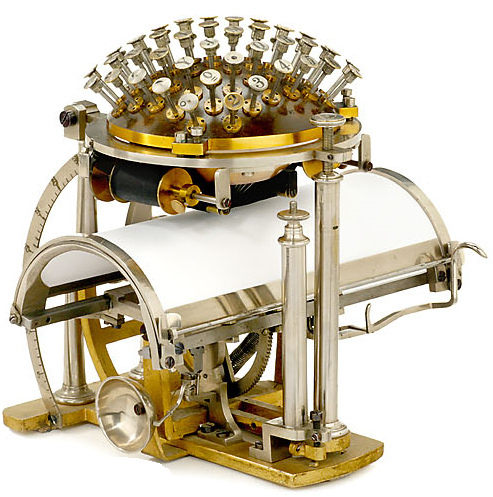
First typewriter invention for the deaf?

There's no mention whether Pastor Rasmus Hans Johan Malling-Hansen's invention on one of the first typewriter (and perhaps the best looking and most beautiful piece of typewriter machinery of all time) produced was inspired to invent this because of his association with deaf people in Denmark.  A way to "write faster" and communicate quicker with deaf people.  I bring that up since he was the minister and principal at the Royal Institute for the Deaf-mutes in Copenhagen and that he excelled as a reformer in his field, education for the deaf and deaf-mutes.
RMH was the driving force behind the development of education for the deaf-mutes in Denmark, particularly in terms of the organizational set up and the formulation of comprehensive goals. In cooperation with Johan Keller he managed to introduce a reform in 1867, whereby the pupils were grouped according to their learning abilities and degree of hearing loss, such that they would all benefit from the kind of education and methods that were best adapted to their situation. He was behind the establishment of the institute in Fredericia in 1881 and was the driving force in the public commission of 1888, whose proposals were accepted and turned into reality after his death: The government took over the private institutes, a new institute was established in Nyborg, and all the schools for the deaf and deaf-mutes were integrated into one general organization and plan. Fredericia was selected as a pre-school at which all deaf-mutes must stay for a year in order for the teachers to assess their individual abilities and needs, before they would gain entrance to the school or institution, whose methods could cater for their specific needs and abilities in the best possible way. RMH's modern and far-sighted vision became a reality! This was well known in Scandinavia as "the Danish division (selection)" and became highly influential in the other Nordic countries.
A description about Rasmus Hans' typewriter and the first invention of the writing ball:
The writing ball was not only the first typewriter to be produced and sold in a relatively large quantity, it is also the fastest typewriter ever made, because of the unique construction of the "ball". Malling-Hansen was experimenting with the placement of the letters already in 1865 - and he succeeded in finding a placement of the letters that made the writing speed extremely fast. Not many people know that the traditional qwerty-keyboard was designed with the goal of preventing the arms from "hanging up" in each other, and in no way was designed to get the fastest writing speed - on the contrary!
I'm surmising at this point whether his typewriter and writing ball invention which was finally patented in 1870 and "mass produced" beginning in 1872 was a subconscious effort on finding ways to communicate faster and better with deaf people rather than by pen and paper. Or perhaps it was a conscious effort of his on finding ways to educate deaf people through the use of his "extremely fast" typewriter even though nothing is documented to say that was the case.  The timing of his typewriter invention occurred during a period while he was the minister and principal at the Royal Institute for the Deaf-mutes in Copenhagen and the fact that he excelled as a reformer in his field, education for the deaf and deaf-mutes would appear suspect as perhaps his primary reason to invent his typewriter was partly because of his association of all things with deaf people.

Now, if you ask me, Rasmus Hans Johan Malling-Hansen's typewriter certainly look quite steampunk to me. Quite a gorgeous piece. There are plenty of steampunk typewriters today. Perhaps the Malling-Hansen's typewriter could be put into a collection of all things steampunk deaf? 


Sunday, May 06, 2012

Steampunk Deaf

Not much in the genre of steampunk of things related to deaf or hard of hearing people other than certain steampunk type of technology like a hearing aid seen in one of the steampunk blogs.


If you remember watching the movie Wild, Wild West with Will Smith and Kevin Kline you will see it has all of the element of steampunk feel to it. And then you may remember McGrath "Bloodbath"
who wore a retro looking "hearing aid" which was retro of that era, anyway.


Here's another true to its form steampunk hearing aid.

Of course, you then have steampunk hands of large proportion and I wonder if a deaf person could make two fully articulating hands of enormous size would he be able to sign with them? Boggles the mind if somebody could do that, steampunk style that is.


Here's a truly big hand.


And this one, too.

Deaf forester instructs on how to get pine cones

Here's Andy, again, a deaf silviculturist (see previous blog of him signing a story about Smokey Bear to deaf kids) who gives an instructional video about preparing for a tree climb and how to get fresh pine cones safely while working on the Coconino National Forest in Arizona. How often do you get to see a deaf forester do an instructional video on tree climbing? Pretty neat, I'd say.


Deaf forester signs to deaf kids on Smokey Bear story

Here's a deaf silviculturist who works for the U.S. Forest Service signs a story about Smokey Bear to a group of deaf kids. And the kids get a surprise visit at the end of the story.

He is one of the many deaf/hh employees who works for the U.S. Forest Service. Not often do deaf kids get exposed to a deaf person who works for the U.S. Forest Service and in full uniform, too. So, this was a great thing that Andy did for the kids that day. And speaking of Smokey Bear, here's my youngest daughter from 10 years ago at a Smokey Bear museum in Capitan, New Mexico which is the birth place of Smokey Bear.

Saturday, May 05, 2012

The adventurous life and love story of Mable

Here's an interesting piece of history with a bunch of black and white photos written by the National Geographic. A piece that covers the human side on the life and adventurous times of Mabel Gardiner Hubbard (late deafened at age 5) who was married to Alexander Graham Bell. What sealed the National Geographic relationship with the Bell family was that Mable and Alexander G. Bell had two daughters together named Elsie and Daisy where Elsie grew up and married Gilbert Hovey Grosvenor who was National Geographic magazine’s first editor-in-chief. That solidified the family ties with the National Geographic company.

Gallaudet University's Rock Festival 2002

Rock Festival as it is known at Gallaudet University has been around quite awhile for well over twenty years, for me that is but this year is their 40th anniversary. If you have been at Gallaudet University long enough chances are you attended some of the Rock Festivals there.  In 2002 a hearing band called "Mutaytor" played at Gallaudet University and on their old discontinued website you can see the many pictures of 2,500 Gallaudet students rocking their night away under the thumping, reverberating blast from 6 foot tall speakers. Do you recognize anybody in those pictures? And if you went to a Rock Festival event while as a Gallaudet student, why did you go and did you like the band?  And, yes, that was 10 years ago but don't feel bad. Mine goes further back.

Tuesday, May 01, 2012

Noah Buchholz's Journey: Part 2 series.

Check out Noah's captioned video series Part 2 about his own communication journey.

Wednesday, April 25, 2012

Oh gawd...I'm deaf...I'm hoh.....

Watch this captioned video. It's great! A deaf/hh guy from the U.K. talking about deafness...his and other people's...and things in general regarding it. Don't be afraid of who you are and don't let your deafness stop you from doing what you want to do in life.

Tuesday, April 24, 2012

sComm ships largest order

sComm has made history by delivering its largest order of UbiDuo communication devices to more than 1,250 Social Security Administration (SSA) field offices around the United States.
These communication devices will enable Social Security staff to interact directly and immediately with clients who are deaf or hard of hearing who walk into SSA office for assistance to discuss their SSI/SSDI benefits. Rather than using paper and pen or waiting for a sign language interpreter to arrive, the staff can turn on the UbiDuo and within seconds begin engaging a conversation with the client. This portable communication tool can be carried anywhere within an office, and its self-powered battery provides power when electrical outlets are not available.

The UbiDuo has a full-size keyboard and screen on each half. Communication is instant, with text showing on both halves as soon as it’s typed, there’s no delay like with instant messaging programs.

Its speed and ease-of-use will enable Social Security staff to better meet the needs of its clients who are deaf, hard of hearing, or other communication challenges. For example, clients who can hear but have difficulty speaking because of a tracheotomy or a stroke can use the UbiDuo.
Below are additional photos of UbiDuo communication devices at the sComm warehouse prior to delivery and on day of delivery. Photos are exclusive for Kokonut Pundit blogsite.


sComm is the engineer and manufacturer of the UbiDuo communication device. sComm is a privately-held company in Raytown, MO. The company was founded in 2005. The idea of the UbiDuo was born out of frustration when father and son were trying to interact with each other face-to-face over breakfast at a restaurant. sComm stands for "simultaneous communications." Face-to-Face Communication solution offers fast and direct communication for the Deaf & Hard of Hearing

Sunday, April 22, 2012

LOcuTUS Two

Spinning off of the LOcuTUS One blog piece I did recently while today I'll discuss perceived rejection from a community and identity of self.

In one Star Trek:TNG show the Borg collective was able to successfully assimilate Captain Picard into their collective by capturing him and forcing him to become a part of the hive as one mind. He lost all sense of personality and identity where as on the Enterprise ship his identity was with his crew, his life experiences and personality that made all the difference.  A ship filled with diversity of  people like Geordi La Forge who is blind but wears a special visor that helps him see better - a technology of the time that allowed him to see more things than the natural eye ever could. Or Counselor Troi who have telepathic abilities. Or Worf's ability as a fearless warrior? A ship where respect for their fellow crew and passengers is seen regardless of race, experience, upbringings, ethnic and cultural differences, and special abilities or even those lacking normal eyesight when it doesn't matter because technology helped overcome blindness.  But the height of irony came when Captain Picard and crew did the unthinkable by welcoming a Borg ("you will be assimilated") named Hugh to come and stay on the Enterprise ship should he decide to do so. Even at the risk of losing the Enterprise when the Borg ship comes looking for Hugh. There were no rejection of Hugh near the end of that episode because the crew on the Enterprise ship finally understood Hugh by getting to know him better once he was disconnected from the Borg hive. He was able to regain some sense of his own humanity, personality and awareness of self to know better about the human race. But in the end Hugh made the decision to return back to the Borg collective for reason not what you might think.

All that reminded me a blog piece I did called "The Solution" about Amy and her experience at rejection and how many people associate with Amy her attempt to communicate in a social setting with a group of signing deaf and hearing people.
I am "Amy," as are about two million other severely hearing impaired walking around… And the abuse we are subject to by the ASL Deafies was so elegantly acted out by none other than an ASL Deafie himself.
But what is interesting is to compare some of the thoughts between an oral and hard of hearing person versus a culturally deaf person regarding the Amy video seen in my "The Solution" blog piece when it came to communicating with other deaf people. Even though Amy made the effort to pick up a few new signs and made an attempt to finger spell her name and picked up a few more signs but was ultimately rejected.

This woman who grew up oral and HOH and appears to have been raised in a non-signing environment responded in the original YouTube video source in the comment section about Amy said this:
I grew up oral and HOH and currently learning ASL. Had this HOH girl a sincere interest in making Deaf ASL friends, she could have at the very least, learned a few signs and bring pen and paper to communicate with both the hearing and the ASL Deaf. This video reinforced what I already knew, being stuck between 2 worlds sucks! I'm rather puzzled this HOH girl still didn't learn to bring pen and paper. Does she want to deliberately make communication harder than it has to be?
Versus Candy who is culturally deaf with culturally deaf parents chimed in another blog about the same video. Candy has a different approach and positive outlook said this:
I happen to know all kinds of deaf/hh folks and when one of them approach me not knowing signs, I do make an effort to involve them, even though they do not know signs. It's rude to be ignoring them and having the mindset that it's too bad they don't know signs. The attitude of those signing deaf folks who treat oral deaf is what hurts the deaf world. I was taught to treat everyone the same and I do. My deaf cultured parents taught me that and they practice the same too.

Typically those that do not want to learn signs would not have made an effort to approach signing deaf people.

Manners is what is lacking among many.
Two different approaches on how to deal with a deaf/hh newcomer to a signing community. Which ones do you think would have had a bigger impact? Candy made a great point seen in the underline bold about those who would approach a group of signing deaf people. Amy would not have made an effort to approach signing deaf people if she didn't want to learn new signs.

And then you have Lotus who is oral and hard of hearing had this to say about the video and more in a discussion forum that took place recently:
Lotus: So, what did you guys think of this video? Personally, I think it makes a compelling argument as to why a hard of hearing person should learn ASL if she wants to integrate into the Deaf community and have the common sense to bring pen and paper if she is struggling to understand what the hearing people are saying. Having grown up oral and HOH, I finally learned that one does not HAVE to remain stuck in between two worlds, that one CAN do something about this and be pro-active about it. They are not doomed to a fate that cannot be changed.

According to one blog by an HOH guy, this video is about how badly HOH people are treated by ASL Deafs even though it's very clear in the video that the Deaf woman tried hard to converse with the HOH girl. In fact, it was the Deaf woman who said hi first. This HOH girl attempts to join an ASL conversation even though she doesn't know the language. The thing is, if two people don't speak the same language, it's rather difficult to hold a conversation. Pretty evident that the HOH blogger harbors negative feelings towards the deaf community, even though he himself also has a hearing problem. I feel sorry for this hearing wanna-be blogger........ One can be deaf and happy although he doesn't seem to think it's possible and that being HOH is a better way to live, even though the video proved that being an oral HOH means being left out of both worlds and it's a miserable place to be in. Have to confess that I was stunned that this HOH blogger seems to think the solution for HOH is to use simcomm where basically you communicate with another person using what looks like a typewriter. yeah, the solution for the deaf/hoh to talk to deaf/hoh is not ASL, it's a cumbersome piece of equipment that looks like a typewriter. Personally, ASL and pen and paper is far far more convenient plus simcomm won't fit in either my back pocket or my evening purse. I'd rather write on a napkin!
Of course, Lotus is talking about me as that "HOH blogger." And she got it wrong about a technological communication solution I often speak of.  But the funny thing is that over the last 24 years I have signed in ASL/PSE and I have never felt rejected by the deaf community because I am in many ways am a part of the deaf/hh community and by convention a part of the hearing community, too. The real problem is the few culturally deaf people who have rejected or not have accepted me for a variety of reasons over something that I have no control of. They are the least of my worries. I have not rejected nor have negative feelings towards the culturally deaf community because I have always recognized their uniqueness and abilities. After all, I did go to Gallaudet University, Lotus did not.

I still interact with both deaf kids and adults and have done so since the days as a student at Gallaudet University since 1988. And it was great yesterday to be with a bunch of deaf kids and their deaf parents helping pull weeds during Earth Day weed round up and help them learn more about the environment. This is one example of many. I think Lotus' confusion and obvious bias rest on the fact that she failed to take the time to know who I am  and instead preferred to make generalized assumptions about myself, wrongly I might add, and what I supposedly believe or how I feel. Instead of assuming, why not ask, Lotus?  My world is not your world, your world is not my world, and I have my own preferences on how and who I want to interact with. I have no desire to make any presumptions about Lotus' own feelings or identity.

I have my own preferences on which culturally deaf people I'd like to be friends with or who I don't mind hanging out with, of course. The same goes with non-signing deaf, hard of hearing and hearing people on who I prefer to be with. I see myself as a hard of hearing person. I also see myself as a deaf person. I wear a hearing aid. I am fluent in sign language. I am fluent in the spoken language and speak effortlessly. I went to Gallaudet University. I like playing ragtime piano. I like listening to talk radio while I drive my truck. I've produced videos in sign language with captioning as part of my signing discussions in DVTV. I am an opinionated person. Yet, I respect other people's opinions rather use ad hominem when some people think it takes the place of an effective argument. I like talking on the phone. I like talking over the video phone. I take advantage of communication technology when I'm at work like real time captioning for video conference meetings or use transcribers at large meetings. I like to talk, listen and be a part of small group of hearing people in a conversation. The same goes for being part of a signing conversation with a group of deaf people as I have done so for more than 24 years. I am comfortable with my identity and who I am. I don't feel "stuck" between two worlds because I enjoy both. I live how I want to live my life. It does not matter if you cannot function at the same level as I can or anybody else. I am happy for who I am and not about what I am. I do not presume what's better for other people to live their lives or be critical of them on how they choose to live their life when it comes to their deafness and the people they associate with. Again, my world is not your world, and vice versa.

As for the supposed limitations there are ways on how a non-signer deaf person could interact with either the hearing or culturally deaf people whether by using pen and paper, sign language, real time captioning, talking and lip-reading, using the hearing aids, cochlear implants or Esteem Envoy implantable hearing device (which is NOT a hearing aid), or using an existing face to face technology that allow communicating in a written language in real time with hearing people. The solutions are many as I've explained many times before for years. Technology has made much of our lives easier when it comes to communication. The real attitude is how you approach a solution that fits you depending on a situation.

The point I made in my earlier blog about the Amy video was about how willing are deaf or hearing people to take the time to have a genuine face to face conversation? Or will they continue to reject others simply because they cannot hear well or do not know sign or have misplaced assumptions about them? The real limitations are those who do not have the patience or take the time to communicate with other people regardless of how it is done and the opportunity to get to know them in person. Candy's example is a powerfully positive one.

Captain Picard and Hugh lived in two different worlds at one time but eventually they had a choice on which world they would prefer to live in. Captain Picard who was once a Borg named Locutus who in the end ultimately accepted Hugh, a longtime Borg, without question and gave him the opportunity to choose which world he wanted to belong. Huge was once part of the human race as a boy was able to experience his long lost identity and human feelings separate from the hive's collective thought while on the Enterprise ship. Huge ultimately decided (as a sacrifice and to save Picard's crew and ship) to return back to the Borg ship and continue to be a Borg. A conscious choice he made. Captain Picard who was once Locutus was able to re-assert his deeply locked away human identity in order to become Picard again who quickly rejoined the human race with the help of the Enterprise crew. Picard was able to retain those feelings and understanding on what it was like to be a Borg, a revulsion and hatred he developed against the Borg collective for violating his human identity when he was forced to become a Borg. But it was that experience that caused him to finally understand Hugh when he became "human" again by asserting his independence using the personal pronoun "I."  There is no "I" for a Borg. And it was Hugh's own past experience once as a young human boy that gave him the ability to understand Picard's human race once Hugh became disconnected from the Borg collective thoughts. Two different worlds and both were able to gain valuable insight from each other only because him and his crew were able to get to know each other in person.

The message? Don't presume to think you know everything about the person until you meet him or her in person and get to know the person better.  It's better not to presume and be critical about it because chances are you'll be horribly mistaken.

UPDATE: A slight edit was done in this blog by removing a nom de plume of one person for the sake of calming people down. Secondly, a clarification. I am not making any parallels between Lotus and Locutus. If you note the spelling and capitalized letters you will see two names. Two different and separate person but the story provides an insight and a message.

UPDATE II:  Linking a person's AD account in my blog? Never did that. Never happened. All I linked was to the YouTube account's name that had the comment response in question that I copied for my blog. There was never any linking to any AD url addresses. I never mentioned anything or linked to anything about AD. There were only two sites that I did discuss and that was YouTube and ND. Instead of jumping to conclusion like always read carefully next time before claiming that I linked to AD.

Thursday, April 19, 2012

Noah Buchholz's Journey: Part 1 series.

Part 1 of the Documentary series following Noah Buchholz's journey at Princeton Theological Seminary as the only deaf student. He uses the UbiDuo face to face communication technology everywhere on campus allowing him to interact with his hearing peers. The UbiDuo has given him more communication freedom than ever before.

When comedy isn't really comedy....

There are times when we would shake our heads at a comedian who tries his hands on at being a deaf person doing the fake signing while in the backdrop a fake interpreter would "interpret" to the laughing audience on what he's "saying." One could chalk this one up as ignorance for the crowd of hearing people with a different life and experience who find it funny. But the other group, the signing community, would see that quite differently. One man's comedy is another man's laughter but one man's comedy can also be another man's disdain with the act deserving the trash can, too.


Sunday, April 15, 2012

Deaf Blue Man Group

There are casting calls for Blue Man Group Casting for Chicago, New York City, and Los Angeles for April, July and August depending on which city. They are asking for your headshot and resume to be sent in prior to the casting dates. If you aren't familiar with Blue Man here's a video of them in action:
I wonder if anybody, deaf or hard of hearing, has ever tried out or plan to try out for the casting this year? I think it'd be great to see a deaf/hh Blue Man Group utilizing their own unique set of skills and ability to interact with the deaf/hh crowd.

Wednesday, April 04, 2012

LOcuTUS One

It's a strange world sometimes in the deaf community, especially when you participate in a forum attended mostly by deaf people, many of them signers. Some are even CIborgs which is a running joke by those who love their CIs who facetiously say this although nothing like Locutus of Borg when Captain Picard of Star Trek became a Borg. They are still human beings. This strangeness I'm talking about is in the form of misunderstandings and rigid thinking that happens once in a while. This usually happens when suspicion abounds which result in one-sided prejudicial thinking. One instance is not understanding the purpose of the UbiDuo thinking it had to do with Simcom which actually happened in a real discussion.
Have to confess that I was stunned that this HOH blogger seems to think the solution for HOH is to use Simcom where basically you communicate with another person using what looks like a typewriter. yeah, the solution for the deaf/hoh to talk to deaf/hoh is not ASL, it's a cumbersome piece of equipment that looks like a typewriter. Personally, ASL and pen and paper is far far more convenient plus simcomm won't fit in either my back pocket or my evening purse. I'd rather write on a napkin!
First of all, the UbiDuo is a Face-to-Face (F2F) communication device that employs typing wirelessly the words to a person across from you using the same communication device. All done using the written language such as English in this case.  Frankly, it's impossible to do Simcom while using the UbiDuo.

I suppose this person somehow mixed up the name of the company sComm calling it as simcomm. sComm is an abbreviation for Simultaneous Communication. A company that makes the UbiDuo product. A communication device that allow wirelessly typing of words between two people, typically one deaf and one hearing person.  UbiDuo users are able to communicate seamlessly and in real time much like what a real conversation takes place.  Up to four people can use the UbiDuo using two separate units. The UbiDuo could also be used between a hearing mute person and hearing person. Or between a stutterer and a hearing person. Regardless, the UbiDuo fills that niche when signing or writing on a piece of paper simply won't do when it comes down to having full and rich conversations all done in real time.

The second misunderstanding is that some people think the UbiDuo replaces ASL. Not true. Many of the UbiDuo users are native ASL users and signers. Even the co-founder and deaf owner of sComm relies on sign language interpreters in large and small settings. But when it comes to a one to one communication opportunities the UbiDuo fills that niche nicely in communicating with other people in real time whether it's doing breaking business deals with hearing clients, conversations in social settings with hearing people such as in bars and restaurants, interactions with hearing customers, impromptu meetings with your hearing boss or supervisor, or catching up on missed family interactions by those who don't know sign language. That niche to fill is rather large when you think about it.

Instead of assuming what the UbiDuo does, please take the time to ask the company or visit their website to learn more about the UbiDuo communication device and the people who have successfully used it.

BTW, I do not get any commission from selling the UbiDuo. The owner of sComm is a great friend of mine. I've known him since 2005. Ever since 2005 when I first learned about his company and began blogging about it only because I believed in his product was the answer on helping close many of the communication gaps between deaf and hearing people. Both he and I share the same philosophy and vision about communication access using technology as a mean to bridge the communication gap between deaf and hearing people. I simply believe in his patented communication device, the UbiDuo. And so I blog about it exclusively because I know it works. It has given countless deaf people greater independence and confidence in communicating with hearing people in real time. I've seen lives changed because of this. I've seen deaf people get promoted because the UbiDuo allowed them the initiative to forge ahead independently. I've seen family members weep because they were able to communicate fully with their son or daughter for the first time. It's sad, yes, but enlightening at the same time that it has helped open doors to thousands of users, both deaf and hearing, all across the globe. It's about gaining greater independence. It's about more freedom and opportunities.

ASL or sign language will always be there. The UbiDuo simply facilitates the communication in real time between a deaf and non-signer hearing person in a variety of settings and situations. Nothing more, nothing less.


Sunday, April 01, 2012

Stem Cell Cure Success for Deaf Babies

Breaking News! Today the St. Moog Catholic University Auditory Clinic and Research Center became the first university in the world to successfully restore sensorineural hearing loss (nerve deafness) in 20 bilaterally deaf babies (age 8 months to 2 years old) in its year long Phase II human application research stage. A gain of 60 to 70 dB was successfully restored in all of the babies previously born with sensorineural hearing loss who had severe to profound hearing loss. The restored hearing remained stable after a year and showed no signs of loss or change. Ear hair cells were successfully grown in the cochlea using dead viruses as natural vectors to deliver each of the baby's own stem cells into their ears. The restoration rate was similar to birds who have the ability to self-restore their own damaged hearing in a matter of weeks. Researchers and parents were equally delighted by the results. It was said that the regeneration of sensorineural hearing loss would take a few decades to achieve but they have already reached that milestone so quickly.

Mark on your calendar April 1, 2012 as the day when parents of deaf babies will soon have the option to restore their babies' sensorineural hearing loss with this easy to use medical application.

Bookworm

Here's a great website which looks through all of the articles in the pre-print service arXiv where you can compare term usage seen in articles as it search for trends in hundreds of thousands of scientific articles. The trend I looked for are "cochlear implant," "hearing aids," "sign language," "cued speech," and "deaf education."

Here are the results:


As you can see since 2011 the number of articles on sign language has dropped dramatically while cued speech, deaf education, cochlear implant and hearing aids jumped up dramatically. For a better up close graph result go here.

For sign language it has peaked twice around 2010 and mid-2011 but it appears to be waning while deaf education, cued speech, cochlear implant and hearing aids appear to be over taking sign language.

What can we infer from all of this is anybody's guess. Perhaps over the next 5 to 10 years we will probably get a better sense of the on going trend. Although in Google Trends it shows that the term "sign language" is on the downward trend which seems to corroborate the Book worm search while other terms in Google Trends appear to be relatively static.

UPDATE: I also looked separately on trends in Google Books Ngram. For books that discuss sign language from 1880 to 2008 you can see it peaked around 1998 and has been going down ever since.  On cochlear implant it peaked around 2002. On hearing aids it peaked in 2000. On deaf education it peaked around 1995.  And on cued speech it peaked around 1997.

Thursday, March 29, 2012

Switched at Birth....Season II: A Cochlear Implant Character?

My wife and I have been enjoying all of the episodes of Switched at Birth and we are now caught up. It's great to see well known actors in the show who are a part of the signing community like the famously well known Marlee Matlin (Melody), the more recently the up and coming but wildly popular Sean Berdy (Emmett), and the newest actor, Ryan Lane (Travis) who is making waves. From all indication the show has been a popular success among many deaf and hard of hearing people in the signing community. With a variety of cast of characters such as the late deafened teen to the native ASL signers to signing and non-signing parents of the switched at birth characters made the show an interesting and enjoyable one to follow. This is a show that gives viewers the chance to see real deaf/hh actors in action and learn something about the signing community. The way I see it, any positive exposure regarding sign language is a good exposure regardless whether one signs well or not. With the shows obvious success, the second season of "Switch at Birth" will likely take place according to a 2nd exclusive interview  (see first interview here) with Katie LeClerc that took place last week:
Any news about a second season?
Katie Leclerc: I saw the creator today at the Up Front function in New York and I was like pushing her for info. I was like, ‘Lizzy, give me something to work off of.’ The only thing, and she might actually kill me for telling you this. I think she’s going to be really mad at me. I’m so sorry. Now I teased you.
You can’t not tell me.
Katie Leclerc: She’s going to kill me. Gilles Marini comes back in this episode and I think that he’s going to try to make a presence in the next season. That’s as much as I can say, and I’m probably going to be yelled for you.
Katie LeClerc plays one of the lead character (who lost her hearing at an early age due to a case of meningitis) as Daphne who was switched at birth managed to pick up signing. A character who is slowly assimilating herself into the signing community. But in real life Katie LeClerc is actually a hard of hearing actress and has Meniere's disease and wears a hearing aid as explained in her first interview in January.  Despite the show's success there are few culturally deaf (Deaf) people who don't like the show based on the fact that the one of the lead actress, Katie Leclerc, who plays Daphne, isn't "deaf enough" according to a recent circulating petition created by a "Deaf ASL teacher" for Deaf people who are against the show and some actors, specifically Katie Leclerc:
ABC Family first dropped the ball by hiring an actress who is not Deaf. Katie Leclerc is an actress that only recently started losing some of her hearing due to Meniere's Disease. The only reason she knew any ASL before the show was because she took it in high school and that was because, In her own words, "I was very bad at Spanish." Leclerc has to take voice lessons in order to "sound Deaf" on the show. Leclerc portrays herself as an ambassador of the Deaf community - "I feel comfortable in the deaf world I feel comfortable in the hearing world," Leclerc said. "I'm glad I can cross over." - There is no crossing over. She is a hearing person that is playing the part of a Deaf character. She is not a part of the Deaf world. Thus, some of the things about her character are not things that are normal for a Deaf person who grew up in the Deaf world - such as her ability to lipread flawlessly, her constant sim-com (talking and signing at the same time), and her signing being jerky and awkward at times. There are many talented and beautiful culturally Deaf actresses that ABC Family could have hired.
Pretty sad and selfish for them to attack Katie Leclerc and say that she is not "Deaf enough."  Even though the petition asserts that she's hearing but in fact a she's a hard of hearing person with Meniere's disease,  a progressive condition that affects balance and hearing and includes odd sensation of movement (vertigo), dizziness, loss of hearing in one or both ears and ringing in the ear (known as tinnitus). Yet many Deaf people don't realize that Katie Leclerc has a hearing loss:
Katie Leclerc: Daphne is a typical, high school girl. She plays basketball. She`s got boyfriends. She gets good grades. And she`s deaf. It was really exciting to be able to portray that. I learned sign language when I was 17 in high school. When I was 20, I found out that I had Meniere`s Disease and I am very, very, very fortunate that I will be able to communicate for the rest of my life, because it gets worse over time.
So you have a hearing loss?
Katie Leclerc: I`m hard of hearing. Yes. One of the symptoms of Meniere`s Disease is the hearing fluctuates.
You lip read, too?
Katie Leclerc: Yes.
What made you learn?

Katie Leclerc: Just a very serendipitous thing. I think things happen for a reason.

Did you ever feel you wanted to switch lives and not have that?
Katie Leclerc: You know, for me, the disease progresses and it gets worse as it progresses, but I`ve been able to bear with it. There are definitely symptoms and some times are harder than others, but my sister`s is far more progressed than mine and to see how her struggle goes and see what she does is sort of inspiring. I`m lucky because I get to know what I have to look forward to so I can prepare for it.
What did you learn from her?

Katie Leclerc: To stay strong. There`s really nothing you can do about it, so I just try to keep a positive attitude.
.
.
Has anyone not wanted to cast you because of the Meniere`s Disease?
Katie Leclerc: Most people are unaware of my hearing loss.
But then you have an few cranky Deaf people who'll complain and set up a petition only because a hard of hearing and signing actress isn't "deaf enough." How surreal can this get in their effort to reject a late deafened teen actress who have begun to learn sign language for her own benefit as well as for the show?

Here's one comment that was made in the petition that attacked Katie Leclerc.
I am a deaf actress and am extremely disappointed in your casting for Daphine. She is not deaf, she has no right to say that she represents Deaf people. She has never lived a deaf life. Not to mention, this show has SO much possibilities to teach people how to bridge a gap between two completely different people, in this case deaf and hearing. And yet, you fall back on sex, drugs and fake drama. Please clean this up, recast Daphine with someone that is actually deaf, who has ability to sign FLUENTLY, and also use speech.
Katie Leclerc is a person with a hearing loss. A late deafened person. She is a hard of hearing person. She knows sign language and continues to get better. She can talk. She can hear some. She wears hearing aids. She is a person that is welcomed in the signing community and not a person to be shunned just because she's not "Deaf enough."  That's rather selfish and cruel. Even though the rest of the cast and extras you see throughout the show's episodes are culturally deaf people, specifically Marlee Matlin, Sean Berdy, and Ryan Lane. That alone ought to be more than enough to go around.

The selfishness by a few Deaf people is utterly surreal.

Now, about the title of my blog, there seems to be a confirmation swirling around on what we could expect for season two of the show "Switched at Birth."  I got word that a writer of the show is thinking about casting another deaf actor who wears a cochlear implant to play a deaf character with a cochlear implant. No word on whether this character will sign or not. But if this is true then I'm sure the show will be even more enjoyable to watch with a variety of deaf and hard of hearing characters with various signing skills that wear hearing aids, cochlear implants or none at all from all kinds of background to come together along with hearing signers as one big happy (but drama filled) signing community in the "Switched at Birth" show. This will allow the viewers to learn more about deaf and hard of hearing people that come in all shape and sizes and help increase the positive exposure and fascination of sign language.

What more  could you ask? Makes sense to me.

Here's to season two!

Thursday, March 08, 2012

Anytime...anywhere....not afraid to communicate.

On an airplane flight in one of his many business flights and being the only deaf person on board surrounded with hearing travelers certainly was not an excuse for him to keep quiet. Wherever he goes whether at a bar, a convention, or on an airplane there's never a lost opportunity to whip up a discussion with a hearing person anytime, anywhere...no problem. And communicate easily, unimpeded in real time conversations and not miss a beat or a single word. Never knowing that by introducing himself to a hearing person could open up a whole new level of networking. Just like the day on an airplane when he bumped into one of the top sports writer for The Kansas City Star newspaper Joe Posnanski who eventually wrote a story about this deaf man and his good friend, Greg Gunderson back in July of 2006. A story that I was directly responsible in reuniting these two old deaf friends who have not seen each other since the days when they were camp roommates at Boys Town.
Jason and engineers spent three years testing the device, working and reworking the design, and interviewing deaf people for ideas. When the prototype was done, Jason needed some people to test it. He contacted Mike McConnell, perhaps the nation’s best known deaf blogger. Mike said he knew the perfect guy.
He wrote: “Do you know about Greg Gunderson, who is trying to become the first deaf NASCAR driver?"
When Jason came across Greg’s name, he did not recognize it. But when he went to the Web site, he saw a photograph, one he had a hundred times before. It was Greg on a snowmobile. Jason remembered everything. This was his old camp roommate. He was trying for something big. And he needed help.
So, Jason got in touch, and they cried as they remembered. Jason’s Independence-based company sComm bought Greg his fire suit and helmet (with the words “Ubi Duo” prominent on both) and he offered Greg his invention to use on the show. This way, Greg could communicate with fans and media members and the other drivers on the show. This way, Jason’s invention could be seen by America.
See, Jason believes in destiny, too.
“The other day, I had a long chat with my brother-in-law on the Ubi Duo,” Jason wrote. “It was the first in-depth conversation we’d ever had. When I went over to their house, I used to be off to the side, alone. It was hard.
“Now, this device … it will change people’s lives. I know it. It will help deaf people do jobs. It will bring family members together. And it will help my old friend Greg become the first deaf NASCAR driver. I know it.”
Greg knows it, too. The story has to end happily. A few weeks ago, Greg came across a room key and he realized: It was to their room at Boys Town. Greg never knew why he kept that key — he was supposed to give it back at the end of the camp — but he did keep it. And every time he thought of throwing it away, something stopped him. Now he knew. He gave the key to Jason.
“What is the key to?” I type into the Ubi Duo.
“The future,” Greg typed.
Indeed. The future continues to look brighter with each passing day for sComm only because communicating with hearing people using the UbiDuo has proved its worth the weight in gold time and time again.  It's the little bold things like talking next to a hearing passenger sitting next to you while showcasing the face to face communication device to a fellow passenger that led to much bigger things. With the UbiDuo deafness becomes a non-issue anytime, anywhere and never an excuse not to communicate with any hearing person.

So, what's stopping you from communicating with a hearing person sitting next to you?  Your deafness? It certainly did not stop Greg Gunderson or Jason Curry.

Sunday, March 04, 2012

Naturally so...

A certain person who used to be a moderator in one forum recently claimed that I made a slanderous remark against a new forum in a recent blog I did. A claim that is certainly unfounded. The problem is that I've always supported competition as I've said before elsewhere. If people think they can build a better mouse trap (i.e.better product, services, etc), go for it. This is exactly how it happened between Deafread and Deaf Village. Both are blog aggregator websites where Deaf Village was borne out of its own need (and frustration) on a matter of principle and ideology in 2008 to build it's own blog aggregator site instead of relying on Deafread's blog aggregator site. In fact, I was one original Deaf Village staff who helped get Deaf Village off the ground in 2008. And yet I am a blog contributor to both Deafread and Deaf Village blog aggregator sites.

The same story goes between DeafvideoTV, Deafcube and ASLrocks.net (now defunct) which are (or were as for ASLrocks) video blog aggregator websites but Deafcube (and ASLrocks) was, too, born out of its own need (and frustration) on a matter of principle and ideology recently to build it's own video blog aggregator site. So, nothing is new under the sun when Naturally Deaf came about a few weeks ago borne out of its own need (and frustration) and as a matter of principle and ideology against All Deaf to build it's own forum.

People are free to make their choices when it comes to competition over the internet and that's what makes America great. There are now more choices to chose from for deaf and hard of hearing people, late deafened, culturally deaf, cochlear implant wearers, CODA, hearing parents of deaf/hh children and people who are simply curious or interested about deafness issues. I've already told a few people about the new forum site to check it out yet the snarkiness and sniggering on congratulating me for helping generate traffic to their new forum continues as I speak which certainly tells the story. 

As I have said before to the new moderator, good luck on the new endeavor and duty as a moderator. I mean it.

Now, back to my blog.

It's understandable that some people would miss my warning that I'd play the devil's advocate (I made it abundantly clear in the beginning) in one of my recent blog.  Long story short, I explained that some people might think of the phrase "naturally deaf" as applied to people would find it odd. Much the same questioning could be said for "naturally blind" and so on. But if people actually think I did make a slanderous statement against the new forum in my recent blog then show exactly where I made that slander. Otherwise it'd be smart to retract that accusation when it was never true in the first place which, ironically so, is the very definition of a slander. Go figure. Yet, I have my own opinions and beliefs regarding forums, blog and vlog aggregator sites. I have the right to express them as I see fit. Even when I believe some favoritism and bias have played a role on influencing moderators. There is no such thing as a bias-free moderator, naturally so. And in retrospect, I'd be wary of joining a deaf discussion forum with that kind of rampant bias and favoritism.

Thursday, March 01, 2012

Forgetting your deafness while not forgetting that you're deaf.

Lately there seems to be a bit of twisting of a particular quote on what Naomi Horton of Indiana Hear said not too long ago in a recent Indiana Hear press release last year in June:
When deaf kids don’t consider themselves deaf… the magic begins.
The context of her quote is quite simple once your read the rest of the press release. It's from a point of view that when kids are having fun and are communicating with each other, they forget that they are deaf. Hence, the "magic begins." That press release provides a much better context in support of her quote.  In fact, in the press release it stated that the kids when asked a question about camp they don't talk about their deafness:
....queried the children about what makes this camp special. A sample of the answers were: “swimming in the lake,” “horseback riding,” and “the friends we make.” None of campers surveyed even mentioned being deaf.
That's the gist of it. They have fun at camp forgetting completely about being deaf. The kids know they have a hearing loss or are deaf and certainly are not ignoring that very fact themselves. 
Tyler McAchren, a Junior at Huntington University, was a chaperone this summer after attending as a camper for three years. McAchren who wears a cochlear implant was asked, “Do you consider yourself deaf?”
“I usually say I’m hearing, but I’m not opposed to using the word deaf either. After all without my implant I am profoundly deaf.”
Hear Indiana’s executive director, Naomi Horton, queried the children about what makes this camp special. A sample of the answers were: “swimming in the lake,” “horseback riding,” and “the friends we make.” None of campers surveyed even mentioned being deaf.
Naomi Horton spoke about the summer camp for deaf and hard of hearing kids with the goal to help build up their confidence and self esteem. Nothing more, nothing less. 
“Camp reminds us all that deafness is no longer a limitation. Our campers amaze me with the gentle way they encourage each other to complete our challenge tasks. Our camp is fostering future leaders, not just within the hard of hearing and deaf community, but within the hearing world at large.”
The kids at summer camp communicate amongst themselves forgetting that they are deaf just like any other deaf kids who communicate whether by speaking, listening or signing.  It is a common thing to forget about our deafness in our effortless moments whenever we communicate with other people but certainly have not forgotten that we have a hearing loss. It'd be ludicrous and delusional to think otherwise.

Tuesday, February 28, 2012

The solution...

Have a hearing loss? Deaf? Hard of hearing? Don't know sign? Have a hard time mingling with hearing people? Watch this video and figure out how another way of doing face to face communication can be done.


The answer is simple. Even Noah Buchholz knows the answer. But the bigger question is how willing will deaf or hearing people take the time to sit down and have a genuine face to face conversation? Or will people continue to reject others simply because they cannot hear well or do not know sign?

Learn to let go of the status quo.

Naturally Deaf?

Recently a phrase "naturally deaf" was brought up where it raised all kinds of questions concerning the expression behind it for deaf people who may use it as sign for "Deaf pride." I get it so don't get me wrong. It's about "acceptance" of oneself, acknowledgement of their deafness, yada yada yada.

Got it.

Yet, the culturally deaf crowd represents barely 2% of the 36 million people with hearing loss in the United States. It's all about personal choice to describe oneself.

But allow me to play the devil's advocate for a moment.

This phrase would make as much sense as saying "naturally blind" or "naturally mute," or, to play the outside of the rules of today's politically correct games, even "naturally mentally retarded" to many people. Their line of thinking would be to ask what's natural about it for those who cannot walk and must use wheelchairs, for example? Exactly what's "naturally" about it some might ask?

In the United States about 2 - 3 infants out of every 1,000 live births will have some degree of hearing loss at birth according to NIH.   About 50% of the babies born are due to genetic factors where some 400 different genes are the root causes of deafness through a variety of genetic mutation. About 15% of those babies born have other conditions that accompanies their deafness or syndromatic (i.e. "multiple disabilities" such as deafness and cerebral palsy) while 25% of them are born only with a hearing loss as a result of a genetic change (non-syndromatic). 

About 25% of cases of deafness are caused by non-genetic factors such as premature birth and illnesses while pregnant like Rubella (German measles), Cytomegalovirus infections, Toxoplasmosis, Herpes infection, and Syphilis. 

And then you have non-genetic causes of deafness after birth such as head injuries, childhood infections (such as meningitis, measles or chickenpox), certain medications (such as the antibiotic streptomycin and related drugs), and even ear infections (otitis media) in rare cases causing permanent hearing loss. 

And the rest of the remaining 25% of the cases of deafness in infants and children are unknown causes.

I might be belaboring this but I see using the phrase "naturally deaf" as an attempt to define oneself in a feel good way sort of thing. And that's fine. Others may choose a different way to express oneself. Not everybody see hearing loss in the same way as the next person. Of course, you don't hardly hear people with a blindness or a vision condition say "naturally blind" and have a forum with that name, too. I'd be just as wary joining a deaf forum under a similar moniker.

Naturally.

UPDATE: In an OCDAC blog I noticed with bemusement of how a few people got it wrong about this blog piece. This piece is about the phrase "naturally deaf" which, to me, appears to be much out of sync aligning with the same idea of people born with mental retardation to be called as "naturally mentally retarded." It just doesn't make sense. I do not need to refer to a website about that phrase and why should I? So, instead these people go about the conspiracy talk.

Lotus got it wrong, eh Weyn?

So did Jill, a serial online bully done via snarkyism and derision at a known deaf-run discussion forum who finally got the perma ban. A hearing woman who was the most addicted forum member who paraded as the savior for deaf people everywhere took the time to go online nearly on a daily basis for hours and went after other forum members who do not agree with her or have opinions she doesn't like. Instead of putting a member on ignore she chose to harass certain members. A woman who, ironically and hypocritically, has a M.Ed in Counseling and a BS in psychology. A woman who was the most addicted member to a particular online discussion forum who posted relentlessly, yet consider the degrees under her belt, her addiction and bullying attitude. It's somebody you don't want to get professional advice from her.  And because of her constant online bullying, I had no choice but to put her on ignore. She continued to berate, "snarkyed," and derided me where others responded to her comments hoping that I would get see her comments. Even those people were eventually put on ignore after I recognized their tactics in getting me to try and respond to "Jill." Her constant bullying soon earned her a permaban after she and others have tried to get me permanently banned for years. I never received a permaban over there or anywhere else. In fact, that one forum was the only forum I constantly attended for several years.

Lastly, there were only two comments I didn't approve. That was because they broke the posting rules. It was not even "numerous comments" that I didn't approve but two. A former moderator and a different person.

Wednesday, February 22, 2012

A journey starts with a single keystroke

This video of Noah Buchholz is part one of many of his series documenting his use of the UbiDuo face-to-face communication device at Princeton Theological Seminary. In his first interview he described how it has empowered him to communicate with hearing people at any time he wanted to. He provided some valuable insight on how it has helped him communicate with hearing people wherever he went. This led him to make new friends and made his education easier along the way. So, come on in, have a spell, and watch Noah Buchholz's journey, Part I.

Wednesday, February 15, 2012

When communication matters....

Watch for it on February 22, 2012 when Noah Buchholz, a deaf Princeton University student, who dared to communicate on his own terms with his hearing peers and staff by using a popular communication technology that enabled him the empowerment he needed.

Thursday, February 02, 2012

Hearing Loss Association of America Surpasses $1.2 Million Dollar Goal

Received an interesting email announcement from HLAA about their fund raising effort in 2011 through their Walk4Hearing fund raising events. It's amazing to see how much they've raised money in one year. Already into 2012 they've raised almost $70,000 which is about 5% of their $1.3 million dollar goal.
Bethesda, MD: The Hearing Loss Association of America is pleased to announce its line-up of 2012 spring and fall Walks in 21 cities across the country. The Walk4Hearing experienced growth for the sixth straight year and surpassed its 2011 fundraising goal of $1.2 million.


Hearing loss is a leading public health concern with 36 million adults reporting some degree of hearing loss, yet most people go untreated. The Walk4Hearing increases awareness about hearing loss, minimizes the stigma associated with it, and raises funds to expand services and programs.


Mike Orscheln, president and CEO of Phonak, is the 2012 National Business Chair. Orscheln stated, “Two years as the Chicago Business Chair and last year taking on national responsibilities has given me an even stronger commitment to help this event become more successful. The dynamics that are occurring in our industry make the collaboration among industry, hearing health professionals and consumers more critical than ever. Let’s make 2012 the biggest and best year ever for the Walk4Hearing!”


National sponsors of the 2012 Walk4Hearing include: AARP, MED-EL, T-Mobile, Advanced Bionics, Cochlear Americas and Phonak.


Director of the Walk4Hearing, Ronnie Adler, commented that dedicated volunteers helped realize a 25% increase in the number of teams and walkers, making the Walk4Hearing the largest walk event for people with hearing loss. There was also an increase in the number of alliance groups which are participants from schools, hearing loss-related organizations, and others that share the proceeds.


Along with Ronnie Adler, Rebecca Lander serves as the National Walk4Hearing Coordinator. Suzanne D’Amico, a veteran of the New York City Walk, joins HLAA as the Northeast Region Coordinator, effective February 1, 2012.

In their website they have a list of cities where this Walk4Hearing will take place. The last city on the list is Washington D.C. to take place on November 4. Take the time and go to one for a good cause. I've met all kinds of people there even those who are deaf and fluent in sign language.

Sunday, January 29, 2012

DJ Demers - hard of hearing comedian

I have never heard of DJ Demers out of Canada who happens to be a hard of hearing stand up comedian. No signing but the typical speaking comedy performances he does. I discovered this guy the other day when I came across a video of him interviewing Sarah Churman on the Sharp Focus website.  An up and coming comedian who have won awards and recognition for his stand up comedy.  He was nominated in 2011 for "Best Stand-up Newcomer" at the Canadian Comedy Awards. He was also a finalist in the 2011 NBC Stand-Up for Diversity Initiative (you can see his name and face there), a finalist in 2011 Cream of Comedy for the $5000 prize, and took 2nd place at the 2010 Toronto Comedy Brawl with cash prizes.

An impressive list so far and for your information DJ Demers wears two hearing aids. He's stereo but I'm mono. And, no, not the contagious kind. Anyways, it's rare to find hard of hearing comedians out there who have done and continues to do stand up comedies. The other well known one is Kathy Buckely. But I'm sure many of you have this lingering question floating in your dainty little heads of yours, does DJ Demers know sign language? Was he born with sensorineural hearing loss or acquired later in life? Etc..etc...etc....(not that many but you get the idea).

And the answers are......

Well, check out my next blog and find out the answers. Well, maybe. I don't know. I'm pretty darned sure you'll get them. Just wait and see. On second thought.....

Saturday, January 28, 2012

Hard of hearing person interviews Sarah Churman

Here's an interesting captioned video interview of Sarah Churman by DJ Demers of Sharp Focus. What makes this an interesting interview is that you have two hard of hearing people talking back and forth on a live video feed with DJ Demers out of Toronto, Canada and Sarah Churman out of Burleson, Texas. They're able to understand each other quite perfectly. The only difference between the two is that DJ Demers wears regular hearing aids in both ears while Sarah wears her Envoy implantable hearing aid in one (but soon to have her other implantable hearing aid that was donated to her for free by Envoy Medical will be activated in March).
D.J. DEMERS is a funny dude who wears hearing aids, but he doesn’t talk about them much.
He was recently nominated for a Canadian Comedy Award for best standup newcomer and was also a finalist in the prestigious Cream of Comedy competition. All this despite his hearing impairment. He also showcased for NBC at the Comedy Store in L.A. for their Stand-Up for Diversity initiative. What makes him diverse? Possibly his hearing aids.
D.J. has appeared in two episodes of the extremely intellectual show, ‘Cocktales’, on the Comedy Network. He has been profiled by the Toronto Star and ‘The Morning Show’ on Global. His videos have been featured in Eye Weekly and Bite.ca, and he has written for the Walrus Laughs and Virgin Mobile Canada. Most of the content had nothing to do with hearing aids.
These days, D.J. hosts and produces a monthly comedy show with Chuckle Co. at the Comedy Bar in Toronto. He is also the host of ‘Sharp Focus with D.J. Demers’ on The Accessible Channel. With his mixture of intelligence, playfulness, and not being able to hear-ness, D.J. is always a crowd favourite.
He also wears hearing aids.
Interesting! Be sure to visit DJ Demers in Facebook and support your hard of hearing comedians! But, hey, I did some stand up comedy before. And it wasn't easy but I sure did have some fun doing it. And ya gotta have a passion for doing it if you want to make something out of it. Although I do have a creative side in me like doing my Uncle Bob's House - a Pepsi parody video (you gotta watch the original Pepsi commercial to understand my parody video).


Ahem, anyway, the video interview of Sarah Churman is already captioned so be sure to turn on the CC button on YouTube if you need captioning. Thank you Sharp Focus for including captioning! The 36 million people with hearing loss in the United States thank you! I maintain my own standard to include captioning to my own videos at every opportunity.

Sarah Churman gets 2nd hearing aid implant

It won't be long until Sarah gets to hear the world in stereo instead of mono. Very cool. She underwent surgery on January 13, 2012 for her 2nd implantable hearing aid and will have her implant activated on March 8, 2012. All this was possible because of  Envoy Medical's generous donation presented by Ellen DeGeneres on her show that helped pay for the cost of Sarah's first surgery and gave her a 2nd implant, including the cost of surgery, for free.


Will her response to her 2nd activation be as dramatic as her first one? I'm sure she will be followed a lot more closely with news cameras around her come activation day. I mentioned in my blog about her first activation that was captured on YouTube that became an instant viral video of the year with nearly 10 million visits to date. People continue to learn about the new surgical implant even though she was all the rage in the news late last year. More people will certainly learn about the Envoy implantable once she gets it activated on March 8.

Good luck, Sarah! Couldn't happen to a better person.

Tuesday, January 17, 2012

Concerned Citizens for Disability Advocacy on Stem Cells for Deaf Babies

A blog called "Concerned Citizens for Disability Advocacy" (CCFDA) shared an opinion about the recent brouhaha by some Deaf people who are against stem cells experimentation in the field of regenerative medicine that could help babies with hearing loss. This blogger on CCFDA explained why he/she will not support such a petition that is against stem cells treatment for sensorineural hearing loss deaf babies.
After reading everything on this petition site Concerned Citizens For Disability Advocacy Blog will not and does not support this petition nor ever will and here is why.
This valuable Stem Cell Research could potentially help millions in the future. Why would anybody in their right mind want to stop research that could help others in the future unless they have some hidden agenda or selfish motives?
What next are these same people who are pushing this petition going to push for laws to take away these same types of children from their parents who are trying to help them or want to help them so others can be helped in return?
What a sad nation and a society we have become when the gift of helping others is being silenced if you will by this exclusive group pushing this petition.
It truly sickens me to no end.
Another blogger of In the Country of the Deaf, the Hearing Man is Culturally Deprived
had this to say:
A year ago I was reminded of this fact when I was trying to “help” people with hearing conditions and was set straight. Deafness is viewed as much a culture and identity to some as it is viewed a “handicap” to others. You can read the article from last year here: HEARING LOSS – GIFT OR A DISEASE?
I have the utmost respect for the culture and identity of the deaf and only want to “help” those who want to be “helped.” (Unfortunately, even words like “help” have huge implications…it seems almost every word I use is charged with the potential for offense.)
I do have one question which is spinning around in my brain at 2am while my tea grows cold and my back whispers conspiracies to my neck. This is not a challenge but merely an effort to know better and learn:
If the “with hearing” child of parents “with hearing” were to suddenly go deaf, the parents would probably do everything within their means to recover the child’s hearing.
If the deaf child of deaf parents were to suddenly gain audism, would the parents do everything within their means to remove the child’s hearing?
I would love to receive people’s reactions to this. Please fee free to comment below.
Healthfully – David
So far, there are a few deaf bloggers who have blogged about this potentially life-changing event.

Monday, January 16, 2012

FDA Approves Phase I Stem Cells for Babies with Hearing Loss

UPDATE: Check out one of the deaf children's progress here.

There's a new FDA approved cord blood stem cell safety study to be done on deaf children age 6 weeks to 18 months who acquired sensorineural hearing loss (nonsyndromic deafness). This is a year long study.
Children’s Memorial Hermann Hospital and Cord Blood Registry® (CBR) are launching the first FDA-approved, Phase I safety study on the use of cord blood stem cells to treat children with sensorineural hearing loss.
The study, which will use patients’ stem cells from their own stored umbilical cord blood, is the first-of-its-kind, and has the potential to restore hearing. This follows evidence from published laboratory studies that cord blood helps repair damaged organs in the inner ear.
The year-long study will follow 10 children, ages 6 weeks to 18 months, who have sustained post-birth hearing loss. Children who are deaf as a result of a genetic anomaly or syndrome are not eligible. To ensure consistency in cord blood stem cell processing, storage, and release for infusion, CBR is the only stem cell bank providing clients for the study.
......
......
Researchers will obtain and process the patients’ stored cord blood for treatment. The cells then will be given to the patients via IV infusion, and patients will be observed for several hours in the hospital.
Patients will return to the hospital to repeat all tests except the MRI at one month and one year, and all tests with an MRI at six months.
“This study is exciting because it might offer a non-surgical option for some children with profound loss,” Linda Baumgartner said. “More importantly, this is the first treatment with the potential to restore normal hearing.”
The new Phase 1 study already began in April 2011 and will end April 2015 although the collection on final study results will end in April 2014. This study will use stem cells from cord blood saved at a cord bank after a baby is born. Stem cells from the deaf baby's cord blood will be done via IV transfusion back into the child. Parents whose deaf children qualify for the trial study will decide whether to try the new procedure or not.

Since this news came out it didn't take long for an outcry in the form of a petition for culturally deaf people and others to decry the IV transfusion stem cell study as:
....inhumane and unethical and condemn this hospital, corporation, other collaborators and the FDA for treating our Deaf infants in this experiment as their guinea pigs.
The original petitioner went so far as to claim such procedure as dangerous and that it carries "long lasting risks" but never elaborated on exactly what those "long lasting risks" are. However, there is a similar but previous safety study using cord blood stem cells on children with cerebral palsy age 1 to 12 years old that began in January 2010. Final data collection on outcome ends in February 2012 which is next month.  Ironically, there appears to be no objection from any particular protest group for this IV transfusion safety study for babies and older on reversing their cerebral palsy condition.
The MCG team follows on the heels of a pilot study at Duke University which is exploring if cord blood can be readily applied to infant’s with palsy like symptoms in the first two weeks after birth. Both teams are looking to verify the anecdotal evidence that cord stem cells can be used to ‘cure’ CP children. If successful, the work at MCG and Duke University may provide parents with hope that storing a child’s cord blood could be an effective shield against cerebral palsy.
Cord blood IV transfusions have been done in children and adults.
To be safe, most cord blood transplants done so far have been in children and smaller adults. Researchers are now looking for ways to use cord blood for transplants in larger adults.
This first ever FDA approved study on hearing restoration (sensorineural hearing loss) for deaf children describes the study:
Acquired sensorineural hearing loss is characterized by a loss of functioning hair cells in the Organ of Corti, with greater hair cell loss correlating with more severe hearing impairment. Children with sensorineural hearing loss experience difficulty developing normal language which usually leads to poor academic and social development. Currently, there are no reparative therapeutic options available, and treatments are designed to augment the diminished function of the injured Organ of Corti.


Pre-clinical data suggest progenitor cell infusions may enhance intrinsic repair mechanisms in the Organ of Corti which may restore hair cells. This treatment could ultimately lead to hearing improvement. Human umbilical cord blood (hUCB) is an available, autologous, stored progenitor cell population available for potential therapeutic use. The primary objective of this study is to determine the safety of autologous hUCB infusion in children with acquired hearing loss. The secondary objective is to determine if functional, physiologic and anatomic outcomes are improved following hUCB treatment in this patient population.
This may turn out to be a promising result since it says that pre-clinical data suggest that such a procedure may restore hair cells thus lead to hearing improvement. This is obviously a much more natural process, if proved successful, involving the baby's own stem cells from the baby's umbilical cord (cord blood) could ultimately turn out to be much better option than cochlear implants. In fact, if successful would shorten the prediction time scale to seveal years on a reversing sensorineural hearing loss instead of a few decades away. Over a year and half a ago in my blog I commented that in 2004 a prediction was made that an application for hearing loss rather than a cure could be at least twenty years away (or by 2024) by Dr. Rubel. In another article in 2004 Dr. Rivolta said a cure could be possible in 10 to 15 years away (by 2014 to 2019). In 2009 in the Department of Otolaryngology University of Miami Ear Institute's newsletter quoted believing they could be 10 years away (or 2019) from a cure at the earliest possible timeline. But most scientists seem to concur that a cure or a very applicable treatment on reversing hearing loss would be seen within their (the scientists') lifetime...and that's not very far off folks.