I've added a painting of Uncle Sam seen on the upper left side of my blog where it is linked to my 2010 blog piece on rules for posting comments in my blog. A very simple guideline that anyone can understand and follow it, even a caveman can do that. I'm making this blog to clarify the one thing that a few deaf/hh people have brought up recently thinking that if they leave their name behind and I know who that person is they fear that I will delete their comment while still in moderation mode.
So far that has never happened. Go figure.
The rules I've posted back in 2010 are quite explicit and it doesn't matter if a person post his or her comments anonymously or post comments using their name identifiable to the public. To use the excuse that "I don't want to post my name because you will delete my comment because you don't like me" is a pathetic one if not a cowardly excuse. Bottom line, it doesn't matter if you want to post your comments anonymously or attach it with your name. My posting rules are to be followed. That is where I draw the line on whether a posted comment gets accepted. Extremely few comments do not get published compared to the thousands that do get through. I am a lot more lax than you think when it comes to moderating comments. But, please, please, do not use the lame excuse that just because you think I don't like you and that once you put your name out and I know who you are thinking that I will delete your comment as a result. Hardly. If you follow my posting rules, you're on safe grounds. Abuse your privilege here then expect your comments not to show up. Quite simple, really. Honest injun!
Wednesday, June 20, 2012

Saturday, June 16, 2012
Hiking for health and leisure
Hiking can be a fun, enjoyable and relaxing form of exercise. I know. I do a lot of hiking (here and here, for example) in my own leisure time. A chance to get outdoors and enjoy the sights, sound, smell, touch and taste of what nature can offer you whether it's plucking some huckleberries along the way to munch on or a get a whiff of wildflowers blooming along the grassy open meadows or seeing the vast openness and grandeur in front of you. Here's a video of a bunch of deaf hikers enjoying their day in the outdoors. Take some time to "get away from it all." Do something bold. Go outdoors and hike!
Thursday, June 14, 2012
Cord Blood Stem Cells Treatment for Children
I just couldn't believe it. I read in one discussion forum where one person made a big stink about a current year long study using a deaf baby's own cord blood stem cells to treat the baby's own sensorineural deafness (which has so far appears to continue to help restore the baby's hearing loss) saying it needs to be experimented on animals first to determine the safety of cord blood stem cells. First off, the blood cord stem cells are compatible only to the baby and not in some animal. That sort of ill-conceived logic was enough to make my jaw drop. Secondly, cord blood stem cells are being used to treat a variety of conditions and even injuries such as Traumatic Brain Injury in children in one study which uses the same IV infusion process as with deaf children in a hearing loss treatment Phase I study.
A ground-breaking clinical trial is now underway at The University of Texas Health Science Center at Houston (UTHealth) is an innovative step in a growing number of studies exploring the potential of stem cell-based therapies to help initiate repair and induce healing of damaged brain tissue. The study is being performed in partnership with Children's Memorial Hermann Hospital, UTHealth's major children's teaching hospital.People need to understand the potential self-healing (literally) factors of using your own cord blood stem cells. According to The University of Texas Health Science Center at Houston (UTHealth) on cord blood stem cells:
The trial will involve children who have sustained traumatic brain injuries and who have access to their own umbilical cord blood stem cells, which were banked at birth. Children who meet the trial qualifications will travel to Children's Memorial Hermann Hospital to receive an IV infusion of their cord blood stem cells. They will then be followed at six months, one year and two years.
"The reason we have become interested in cord blood cells is because of the possibility of autologous therapy, meaning using your own cells. And the preclinical models have demonstrated some really fascinating neurological preservation effects to really support these Phase 1 trials," says Charles S. Cox, M.D., Children's Fund Distinguished Professor of Pediatric Surgery and Pediatrics at the UTHealth Medical School, director of the Pediatric Trauma Program at Children's Memorial Hermann Hosptial, and principle investigator of the trial. "There's anecdotal experience in other types of neurological injuries that reassures us in terms of the safety of the approach and there are some anecdotal hints at it being beneficial in certain types of brain injury."
The Phase I safety study will enroll 10 children ages 18 months to 17 years who have suffered moderate to severe traumatic brain injury (TBI) and are within 6 to 18 months of their injury.
Cord blood is one source of stem cells that has shown promise in preclinical research and is now being explored in experimental treatments for patients with brain injury. In the preclinical or lab setting, research has shown that cord blood stem cells have the ability to divide and change into neural-like cells. Additionally, these stem cells have been shown to migrate to the area of injury, and to secrete therapeutic factors, which may help repair brain damage. Further preliminary findings from studies underway at UTHealth indicate that cord blood stem cells may also alter the body's immune response to injury, by interacting directly with the organs and cells of the immune system that enable the body to better repair itself.In other words, you could possibly (and literally so) heal thyself using your own cord blood stem cells by enabling your body, in the example of hearing loss in babies, to better repair itself. Especially among babies who gets treated early on and with the help of their own cord blood stem cells, and if it turns out to be successful for the full restoration on hearing, then it becomes a cure. This process would allow deaf babies early on take advantage of the 4 year window of opportunity to take advantage of the active auditory cortex and be able to grow up as a hearing person in every respect. With this Traumatic Brain Injury study and the Hearing Loss study. We should know more the results of these studies by next year on whether cord blood stem cells treatment is a success or not.
Communication is a two way street...captioning, please!
The one thing I've learned in life is that people's perspectives are different from each other based on their life experiences, their upbringings, their interests, and the people they associate with on a daily basis. Those are the things that makes a person for who he or she it. I have met all kinds and are friends with them. Those who have mild hearing loss to those who are profoundly deaf to those who are culturally deaf to those who are hearing whether they know signing or not. And then you have those who prefer to speak/listen to those who prefer to sign only to those who prefer other methods of communicating. They have their own way of communicating and I respect that. That is not for me to judge. But the one common thing we all have in connection, especially among the 36 million people in the United States with hearing loss, is that many of us need captioning in our everyday lives.
But the funny thing is that some people do have a habit of judging others simply because they can hear a little bit better, talk a little bit better, sign a little bit better or the fact they prefer a different way of communicating. So, exactly what is the difference if deaf people on a theater stage signs in ASL but provide no captioning for the audience versus hearing people on a theater stage talking with no captioning for the audience to see what's being spoken? Both are purposefully excluding people who can't hear quite as well to understand fully the spoken words and those who know some, little or no sign language to understand fully what was signed. Both situations discriminate against the majority of people with hearing loss. Both situations do not invite people into their world because of their own ignorance. Just because a person is deaf or hard of hearing does not mean one is fluent in sign language or knows sign language. Just because a deaf or hard of hearing person can hear some words being spoken does not mean one can hear all of the words being spoken on a theater stage, on television, in a social setting, in a movie theater, and so on.
Why is it ok to have sign language interpreters at a rock concert but not captioning to help caption the lyrics being sung and to help caption what's being said on stage for the listening audience? Why is it ok to have a signing concert but no captioning for those who may not be able to understand it all or do not know sign language? Why is it ok to have a Deaf Awareness Day at Six Flags as a way to help promote awareness about deaf and hard of hearing people but only provide sign language interpreters throughout the park when being deaf or hard of hearing does not mean people magically know sign language? Communication is a two way street benefiting a variety of people with hearing loss and communication preferences. Providing captions help them feel they as if they are a part of a larger family.
Tuesday, June 12, 2012
Sunday, June 10, 2012
The New Stem Cells Generation - going from deaf to hearing.
The stuff of science fiction has now arrived where Madeline becomes the first of many toddlers born deaf to get their first cord- blood stem cells treatments in the effort to restore their sensorineural hearing loss. This procedure continues to show success and Madeline's hearing continues to improve.
This will be the start of a new generation of cord-blood stem cell babies and toddlers born deaf to become, in theory, hearing with the help of their own blood-cord stem cells. An exciting era in regenerative medicine for parents of deaf children. This new cord-blood stem cell procedure was covered in my blog piece in January 2012 for your review.
Once proved successful parents of deaf babies will see this as the preferred treatment to help restore their child's hearing loss. This will certainly be a much preferable route (and cheaper, too) than to choose cochlear implant. Now the question becomes, will this eventually destroy the cochlear implant industry? Only time will tell.
Madeline Cooper, who is nearly 2 years old, is the first person in the nation to take part in a new Food and Drug Administration-approved study of stem cell treatment of sensorineural hearing loss.
Children’s Memorial Hermann Hospital in Houston and California-based Cord Blood Registry will eventually enroll another nine children in this first phase of the study.
Unlike some advertised stem cell treatments that may cost patients tens of thousands of dollars — and, according to critics, are little more than quackery — the Conners paid nothing to take part and have been promised no specific results.
The process is simple: Doctors inject the children with stem cells from their own stored umbilical cords. Because it is the patients’ own blood, there is little chance the treatment will produce side effects.
In theory, the treatment will adjust patients’ immune systems to encourage their bodies to repair themselves. In truth, researchers have no idea if it will work.
Earlier Italian studies on mice concluded that stem cells may help the body repair damaged cells in the ear and restore some hearing in these types of cases, according to a 2008 published report in the University of South Florida journal Cell Transplantation.Madeline's hearing loss has gone from extreme to moderate hearing loss since undergoing the treatment. A definite improvement. This stem cell treatment will continue and may take a few years to help fully restore hearing loss. We will not know how fast this rate of restoration will take place over the next several months to a few years. We will know more once the Cooper family head back to Texas in July, and again in January of 2013, to get a more detailed assessment of Madeline’s improvement.
This will be the start of a new generation of cord-blood stem cell babies and toddlers born deaf to become, in theory, hearing with the help of their own blood-cord stem cells. An exciting era in regenerative medicine for parents of deaf children. This new cord-blood stem cell procedure was covered in my blog piece in January 2012 for your review.
Once proved successful parents of deaf babies will see this as the preferred treatment to help restore their child's hearing loss. This will certainly be a much preferable route (and cheaper, too) than to choose cochlear implant. Now the question becomes, will this eventually destroy the cochlear implant industry? Only time will tell.
Friday, May 25, 2012
Deaf student picked for flight program
It's not often you get to see stories about deaf people becoming airplane pilots. Well, Jason Jernigan is taking up that challenge to become one of the many deaf and hard of hearing pilots in the U.S.
Florida State University Panama City senior Jason Jernigan will undertake five weeks of flight training at Purdue University in Indiana to show that his deafness is not a handicap.
Jernigan, of Youngstown, is the second deaf person to train with Able Flight to learn flight and ground operations. He is one of six men who have been chosen from across the country to win a scholarship for the third year of Able Flight-Purdue University flight training.
“I want to fly because it is one of my life goals,” Jernigan wrote in an email interview. “I really never thought I would get the opportunity. I want to conquer the challenge. I also want to show people that deaf people can do anything a hearing person can do.”Well who doesn't want to learn how to fly an airplane? If you're up to the task, why not? Ask Stephen Hopson who made aviation history by becoming the world’s first deaf pilot to earn an instrument rating, which actually requires the use of a radio when flying though inclement weather.
Jernigan will leave Florida on Saturday for the program. He has no prior flight experience, but he has played a flying computer game. He believes the biggest challenge will be communications between him and his instructors.
“I will use sign language, iPad, a computer and UbiDuo machine,” Jernigan wrote. “Mostly I will use an UbiDuo (communications device). … [I]t should help greatly with both my pre-flight and post-flight briefing with my instructor.”
The university will benefit from expanding their training to include people with disabilities, according to Charles Stites, the executive director of Able Flight.Good luck, Jason. Hope the skies will be friendly for ya!
Bad Advertisement during Tax Season
I drove through a town and saw this and took a picture of it when I noticed the building was empty. You can probably guess why. It's enough to make you not go in when tax season cometh. Why take the chance?


Thursday, May 24, 2012
The mocking of dea(th)f...
One of the worst thing one can do is to air online in a vlog or blog the apparent glee or dispassionate display of somebody else's death who is related to a deaf person known in the deaf and hard of hearing community. Either show a modicum of respect in your blog or vlog or don't talk about it at all. By showing disrespect online makes that person a boorish and dispassionate soul. If it's indifference then keep it to yourself privately and away from the public view. By making it public ranks (almost) right up there on wishing the death of a deaf parent's child just because one doesn't like the deaf parent reeks of insanity.
Wednesday, May 23, 2012
A Dine and Sign TV Internet Show
Here's an interesting and fun show to watch called "Dine and Sign." A humorous show between a hearing son named Alex and his deaf father having some insightful and funny discussions done in sign language. There are now 35 episodes or almost 3 hours worth of shows beginning on September 26, 2011 broadcasted by Podsmiths Internet Televsion on YouTube. Since then the show has slowly gained a following. If you want to talk and interact with the Dine and Sign please visit their Facebook page.
What makes this show fun and easy to watch is the accessibility they provide. Each show comes with captioning, signing, and a voice-over for each of the two father and son duo sparring lightheartedly with each other over a variety of topics. With a combination of communication access available it can reach a much broader audience than just the signing community. If you ever want to see what the interaction is like between a deaf father and hearing son then come and watch their first episode and catch up with the rest of their shows at your convenience. Dine and Sign, not exactly a three course meal but satisfying.
Episode one: What's the problem with long hair?
Deaf pitcher aims for pro baseball
It is not everyday you get to hear of a deaf pitcher who can pitch 90 mph fastballs and have a good chance getting into the major leagues. Scouts are certainly taking a hard look at him.
Tuesday, May 22, 2012
Technology is king for deaf users when it comes to communication
Technology is the key to success for deaf and hard of hearing people. It is true today and it will be more so true into the very near future when it comes to helping provide communication to deaf and hard of hearing with the rest of the world. Google has come out with a new fangled technology that has been in the works for some years called Google Glasses where it hints at speech-to-text display for deaf users:
Perhaps most interestingly, one patent shows Google is working on a system to help hard-of-hearing and deaf users detect and interpret nearby sounds. The glasses' heads-up display would show arrows and flashing lights to indicate the direction and intensity level of the sound, and even display the words nearby people are speaking. The patent, #8,183,997, was issued to Google today and is titled "Displaying sound indications on a wearable computing system." The system would integrate a speech-to-text feature that determines the text of speech and displays it for the wearer of the glasses.This concept on augmented reality will be a boon to deaf and hard of hearing users in the near future by allowing the extra-dimension of space, time and information of sound and visuals through the use of these glasses.
Lou Ferrigno gets Envoy Esteem hearing implant
I was watching the last episode of Celebrity Apprentice when Lou Ferrigno announced during the live show that he can now hear better with his new Esteem implantable hearing device.
Lou Ferrigno, the actor who played the Hulk on the 1970s TV show "The Incredible Hulk," has begun using an implantable hearing aid from Minnesota's Envoy Medical Corp. Ferrigno, who's had hearing problems since he was young, said last weekend on the finale of Celebrity Apprentice (he was fired in April) that he received the Esteem medical implant, made by White Bear Lake-based Envoy.In fact, this was successfully kept underwraps until Medical Envoy released a press release yesterday, the day after the show that was aired on Sunday, about Lou and his new implant and successful it was that Lou even cried once it was activated.
Profoundly hard of hearing since two years old, Lou Ferrigno revealed last night on The Celebrity Apprentice that he recently underwent a surgical procedure to restore his hearing, with the Esteem® Device, manufactured by Envoy Medical Corporation. The device is a fully implantable prosthetic cochlea stimulator, designed to do just that. It has no microphones or speakers. It is invisible. Except that Lou knows it was implanted, he has no sense of it being in his body. But he can hear. And according to Lou Ferrigno, it "is a miracle." "Lou's dream has always been to hear like everyone else," said Carla, his wife of 32 years, who encouraged Lou to have the procedure. Now, Lou says he has "natural hearing and can hear things he has never heard before or could have ever hoped to hear." Birds chirping, rain on his roof, his alarm clock in the morning (scares the heck out of him, he says laughing) the tiniest sounds of his fingers moving together, the refrigerator's quiet motor, but most importantly, the ability to hear people in everyday conversation, even in a noisy environment, like a restaurant. "Everything is so loud and so clear," says the actor, who is still trying to figure out certain, never before heard sounds. Ferrigno said he "can't wait to get his second ear done,"
The device was implanted by Dr. Michael Murray of San Jose CA, who has performed hundreds of Esteem® procedures and is booked through September. Lou Ferrigno's surgery was performed in Houston, Texas at Envoy Medical's private ("decadent," according to Murray) surgical center. The entire procedure costs approximately $37,000 for the device and the surgery, and according to Ferrigno, "is worth a lot more." Approved in a 15 to 0 unanimous, independent panel vote by the FDA, the Esteem® is indicated for moderate to severe hearing loss, in people with sensorineural hearing loss (about 85% of all hearing loss sufferers). It replaces conventional hearing aids for those who qualify. The Esteem® Device is also approved by the VA (Veterans Administration) for those who qualify and have it prescribed by their VA audiologist and ENT specialist.
The device works by leveraging the natural anatomy of a person's own body. Sound enters the ear naturally. The natural vibrations of the eardrum are sensed and sent to a microprocessor implanted under the skin behind the ear. The vibrations are intensified and sent to the cochlea via the stapes. The tiny remaining hair cells in the cochlea pick up the vibrations and send them to the brain where they are interpreted as sound. The result, according to the successful recipients, including Lou Ferrigno, is beyond anything a hearing aid can offer. Ferrigno is still amazed at how well it works. "No more hearing aids for me," Lou Ferrigno exclaims with a huge smile on his face. Tears fell from his eyes upon activation. Ferrigno, dumbfounded, said "he was advised by his audiologist not to have the procedure." "Go Figure?" said Ferrigno. Lou said he "hasn't felt this good since he won the Mr. Universe competition."This is great for Lou. I'm sure he's happy with it as you can see.....just like Sarah Churman.
Saturday, May 19, 2012
Bullying
Fortunately I have not been a victim of bullying since I don't see myself as a victim in the first place. Rather I see the perpetrator as someone who wants attention in the effort to raise his or her self-esteem by targeting certain people with their rants and hate. For years as a blogger I've been a target of bullying-tactics by a few deaf people who have graced my blogsite of time's past. The same people who have attacked those commenting in my blog comment box and used profane language against them. Ultimately I was forced to ban them from my blogsite after warning them to cease against attacking people who leave comments in my blog. Even that didn't always work because they usually find a way to continue with the attacking and bullying. But in my own wisdom I've learned to ignore those people who insist on finding ways to target me.
What prompted me to blog about this was because of an article I read on the psychology of bullying asking an interesting question, "Bullies Have Low Self-Esteem Or High Self-Esteem?"
More on bullying....
If you come across a bully, do not try and engage with a bully. Best weapon is to put that online bully on ignore. Or, if you can, try and ban that person. That's what I did and I was able to take that control away from the few bullies who knew no better. It takes confidence to wrest control away from an online bully by the mere simple act of ignoring the bully in the first place. You have that power.
What prompted me to blog about this was because of an article I read on the psychology of bullying asking an interesting question, "Bullies Have Low Self-Esteem Or High Self-Esteem?"
But current research shows that most bullies actually have high self-esteem. Bullies usually have a sense of entitlement and a feeling of superiority over others, and lack compassion, impulse control and social skills. They enjoy being cruel to others and sometimes use bullying as an anger management tool, the way a normally angry person would punch a pillow. Research does support the fact that bullies have low empathy and don’t know how it feels to be in someone else’s shoes.I never realize that a person who bully sometimes uses it as an anger management tool. That one surprised me but I certainly understand that such attitudes and actions give them the feeling of superiority over others and enjoy being cruel to them in a variety of ways over the internet. Such cruelties include name calling, put downs, smearing, lying or going after their families or spouses by targeting them in order to get to his/her main target.
More on bullying....
As long as bullies are able to manipulate another person or a situation, their self-esteem goes up. Once bullies lose control of their victim, or realize that they can’t manipulate situations to their liking, their self-esteem goes down. This causes them to look for new victims to manipulate and control so that their self-esteem can go up again. The bullying in itself almost becomes an emotional fix that bullies need in order to feel good about themselves.Which is why it's important to ignore certain bullies for their bullying tactics because by doing so you are not giving them any opportunity for control or the opportunity to try and manipulate you. If you can do this try and block the person from your blog, YouTube, Facebook or anywhere else. The bullies I've come across in the past I see them almost as the equivalent of a druggie who seeks emotional fixes in order to get that same "high." It's almost a description of stalker looking for his/her next fix.
If you come across a bully, do not try and engage with a bully. Best weapon is to put that online bully on ignore. Or, if you can, try and ban that person. That's what I did and I was able to take that control away from the few bullies who knew no better. It takes confidence to wrest control away from an online bully by the mere simple act of ignoring the bully in the first place. You have that power.
Wednesday, May 09, 2012
Deaf Echo Attack Website?
This just happened not too long ago and it concerns me a great deal regarding the security and protection for my laptop when I attempted to access Deaf Echo's website and got this warning:

I'm not sure exactly what's going on over there and people should be made aware of this. I have visited the Deaf Echo numerous times yet this Attack Page warning pop up concerned me greatly. I'm not sure what to do at this point whether to continue on or not. The Safe Browsing Client by Google in the Safe Browsing diagnostic page explains why the warning was put up.
Some of you might be wondering if this blog is a malicious blog piece aimed at the owner despite our differences. Hardly the case when I'm given the Safe Browsing diagnostic page on explaining the warning. I'm sure the owner is not aware that there might be some programs installed on his Deaf Echo community blogsite that may not be healthy for computer laptops of those visiting their website. The owner will need to rectify this problem on his own accord. Once the problem is corrected I will provide an update. I sure do like to visit Deaf Echo again.
Any computer nerds out there that can add to this piece of warning info? This is the first time a warning like this has ever happened.
UPDATE: The Google search page for "Deaf Echo" has put out a warning, too. The owner of the Deaf Echo website needs to correct whatever is causing that problem quickly.
UPDATE II: Looks like whatever caused the warning has now been corrected.
Monday, May 07, 2012
First typewriter invention for the deaf?
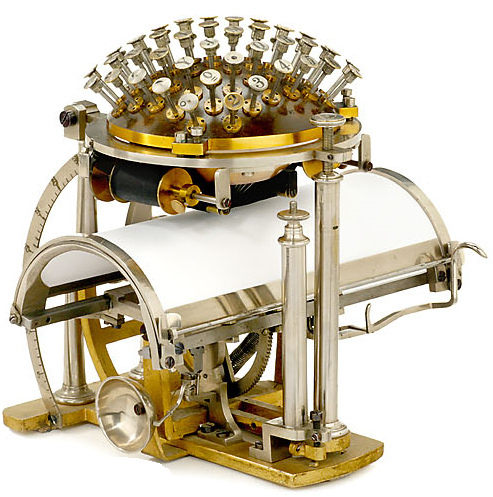
There's no mention whether Pastor Rasmus Hans Johan Malling-Hansen's invention on one of the first typewriter (and perhaps the best looking and most beautiful piece of typewriter machinery of all time) produced was inspired to invent this because of his association with deaf people in Denmark. A way to "write faster" and communicate quicker with deaf people. I bring that up since he was the minister and principal at the Royal Institute for the Deaf-mutes in Copenhagen and that he excelled as a reformer in his field, education for the deaf and deaf-mutes.
Now, if you ask me, Rasmus Hans Johan Malling-Hansen's typewriter certainly look quite steampunk to me. Quite a gorgeous piece. There are plenty of steampunk typewriters today. Perhaps the Malling-Hansen's typewriter could be put into a collection of all things steampunk deaf?

RMH was the driving force behind the development of education for the deaf-mutes in Denmark, particularly in terms of the organizational set up and the formulation of comprehensive goals. In cooperation with Johan Keller he managed to introduce a reform in 1867, whereby the pupils were grouped according to their learning abilities and degree of hearing loss, such that they would all benefit from the kind of education and methods that were best adapted to their situation. He was behind the establishment of the institute in Fredericia in 1881 and was the driving force in the public commission of 1888, whose proposals were accepted and turned into reality after his death: The government took over the private institutes, a new institute was established in Nyborg, and all the schools for the deaf and deaf-mutes were integrated into one general organization and plan. Fredericia was selected as a pre-school at which all deaf-mutes must stay for a year in order for the teachers to assess their individual abilities and needs, before they would gain entrance to the school or institution, whose methods could cater for their specific needs and abilities in the best possible way. RMH's modern and far-sighted vision became a reality! This was well known in Scandinavia as "the Danish division (selection)" and became highly influential in the other Nordic countries.A description about Rasmus Hans' typewriter and the first invention of the writing ball:
The writing ball was not only the first typewriter to be produced and sold in a relatively large quantity, it is also the fastest typewriter ever made, because of the unique construction of the "ball". Malling-Hansen was experimenting with the placement of the letters already in 1865 - and he succeeded in finding a placement of the letters that made the writing speed extremely fast. Not many people know that the traditional qwerty-keyboard was designed with the goal of preventing the arms from "hanging up" in each other, and in no way was designed to get the fastest writing speed - on the contrary!I'm surmising at this point whether his typewriter and writing ball invention which was finally patented in 1870 and "mass produced" beginning in 1872 was a subconscious effort on finding ways to communicate faster and better with deaf people rather than by pen and paper. Or perhaps it was a conscious effort of his on finding ways to educate deaf people through the use of his "extremely fast" typewriter even though nothing is documented to say that was the case. The timing of his typewriter invention occurred during a period while he was the minister and principal at the Royal Institute for the Deaf-mutes in Copenhagen and the fact that he excelled as a reformer in his field, education for the deaf and deaf-mutes would appear suspect as perhaps his primary reason to invent his typewriter was partly because of his association of all things with deaf people.
Now, if you ask me, Rasmus Hans Johan Malling-Hansen's typewriter certainly look quite steampunk to me. Quite a gorgeous piece. There are plenty of steampunk typewriters today. Perhaps the Malling-Hansen's typewriter could be put into a collection of all things steampunk deaf?
Sunday, May 06, 2012
Steampunk Deaf
Not much in the genre of steampunk of things related to deaf or hard of hearing people other than certain steampunk type of technology like a hearing aid seen in one of the steampunk blogs.

If you remember watching the movie Wild, Wild West with Will Smith and Kevin Kline you will see it has all of the element of steampunk feel to it. And then you may remember McGrath "Bloodbath"
who wore a retro looking "hearing aid" which was retro of that era, anyway.

Here's another true to its form steampunk hearing aid.
 Of course, you then have steampunk hands of large proportion and I wonder if a deaf person could make two fully articulating hands of enormous size would he be able to sign with them? Boggles the mind if somebody could do that, steampunk style that is.

Here's a truly big hand.

And this one, too.


If you remember watching the movie Wild, Wild West with Will Smith and Kevin Kline you will see it has all of the element of steampunk feel to it. And then you may remember McGrath "Bloodbath"
who wore a retro looking "hearing aid" which was retro of that era, anyway.

Here's another true to its form steampunk hearing aid.


Here's a truly big hand.

And this one, too.

Deaf forester instructs on how to get pine cones
Here's Andy, again, a deaf silviculturist (see previous blog of him signing a story about Smokey Bear to deaf kids) who gives an instructional video about preparing for a tree climb and how to get fresh pine cones safely while working on the Coconino National Forest in Arizona. How often do you get to see a deaf forester do an instructional video on tree climbing? Pretty neat, I'd say.
Deaf forester signs to deaf kids on Smokey Bear story
Here's a deaf silviculturist who works for the U.S. Forest Service signs a story about Smokey Bear to a group of deaf kids. And the kids get a surprise visit at the end of the story.
He is one of the many deaf/hh employees who works for the U.S. Forest Service. Not often do deaf kids get exposed to a deaf person who works for the U.S. Forest Service and in full uniform, too. So, this was a great thing that Andy did for the kids that day. And speaking of Smokey Bear, here's my youngest daughter from 10 years ago at a Smokey Bear museum in Capitan, New Mexico which is the birth place of Smokey Bear.

He is one of the many deaf/hh employees who works for the U.S. Forest Service. Not often do deaf kids get exposed to a deaf person who works for the U.S. Forest Service and in full uniform, too. So, this was a great thing that Andy did for the kids that day. And speaking of Smokey Bear, here's my youngest daughter from 10 years ago at a Smokey Bear museum in Capitan, New Mexico which is the birth place of Smokey Bear.

Subscribe to:
Posts (Atom)